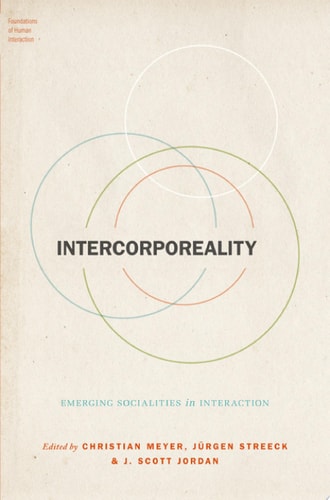
Intercorporeality
0
0
As an Amazon Associate and affiliate partner, Menrva Books earns from qualifying purchases. Learn more
Author Description
This Book Draws Inspiration From Maurice Merleau-ponty's Concept Of Intercorporeality To Offer A New, Multidisciplinary Perspective On The Body. By Drawing Attention To The Body's Ability To Simultaneously Sense And Be Sensed, Merleau-ponty Transcends The Object-subject Divide And Describes How Bodies Are About, Into, And Within Other Bodies. Such Inherent Relationality Constitutes The Essence Of Intercorporeality, And The Chapters In This Book Examine Such Relationality From A Host Of Diverse Perspectives. The Book Begins With An Introductory Chapter In Which The Editors Review The Current Research On Bodily Interaction, And Introduce The Notion Of Intercorporeality As A Potentially Integrative Framework. The First Section Then Offers Four Chapters Devoted To Clarifying Theoretical And Developmental Perspectives On Intercorporeality. Section 2 Contains Three Chapters That Provide Insight On Intercorporeality From Evolutionary, Historical, And Cross-sectional Perspectives. In Section 3, Four Chapters Examine The Intercorporeal Nature Of Meaning-making During Human Interaction. Section 4 Then Presents Three Chapters That Explore The Intercorporeal Nature Of Multi-agent Interactions And The Role That Non-animate Bodies (i.e., Objects) Play In Such Interaction. Throughout All The Chapters, The Authors Work To Integrate Research In Their Specific Discipline Into The Larger, Transdisciplinary Notion Of Intercorporeality. This Collection Provides An Indisputably Unique Perspective On Bodies-in-interaction, While Simultaneously Offering An Interdisciplinary Way Forward In Contemporary Scholarship On Bodies, Meaning, And Interaction.
Menrva's Summary
THE THESIS
This book investigates the concept of intercorporeality as a foundational, integrative framework for understanding human interaction and the relational nature of the body. The editors, Christian Meyer, J. Scott Jordan, and Jürgen Streeck, curate a collection of scholarly contributions that synthesize insights from phenomenology, evolutionary biology, and social science. By building upon Maurice Merleau-Ponty’s philosophical work, the authors argue that the body is not a static object but a dynamic participant in a shared, relational environment that transcends traditional subject-object dichotomies.
THE SCOPE MAP
What You Will Find
- Theoretical and developmental frameworks regarding bodily interaction
- Evolutionary, historical, and cross-sectional analyses of human behavior
- Examination of meaning-making processes during social interaction
- Analysis of multi-agent interactions and the role of non-animate objects
Scope Limits
- The text does not provide a singular, unified theory but rather a collection of diverse disciplinary perspectives
- It does not focus on clinical or therapeutic applications of body-based interventions
THE AUTHORITY PERSPECTIVE
Scholars in the fields of phenomenology and social interaction frequently cite this collection as a vital resource for bridging the gap between philosophical theory and empirical research. Experts note that the text maintains a high level of academic density, making it most suitable for researchers and advanced students interested in embodied cognition.
Page Count:
304
Publication Date:
2017-01-01
Publisher:
Oxford University Press
ISBN-10:
0190210478
ISBN-13:
9780190210472
Psychology
Philosophy
Phenomenology
Sociology
Human Interaction
Community Tags
Similar Books