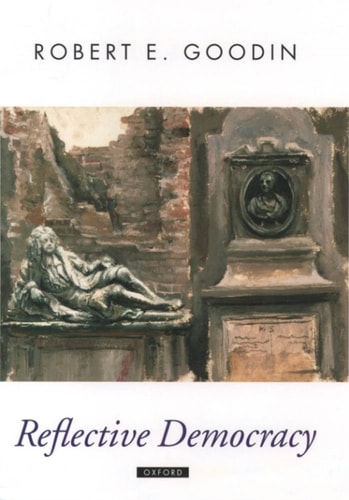
Reflective Democracy
0
0
As an Amazon Associate and affiliate partner, Menrva Books earns from qualifying purchases. Learn more
Author Description
Democracy used to be seen as a relatively mechanical matter of merely adding up everyone's votes in free and fair elections. That mechanistic model has many virtues, among them allowing democracy to 'track the truth', where purely factual issues are all that is at stake. Political disputes invariably mix facts with values, however, and then it is essential to listen to what people are saying rather than merely note how they are voting. The great challenge is how to implement that deliberative ideal among millions of people at once. In this strikingly original book, Goodin offers a solution: 'democratic deliberation within'. Building on models of ordinary conversational dynamics, he suggests that people simply imagine themselves in the position of various other people they have heard or read about and ask, 'What would they say about this proposal?' Informing the democratic imaginary then becomes the key to making deliberations more reflective - more empathetic, more considered, more expansive across time and distance. Oxford Political Theory presents the best new work in contemporary political theory. It is intended to be broad in scope, including original contributions to political philosophy, and also work in applied political theory. The series contains works of outstanding quality with no restriction as to approach or subject matter.
Menrva's Summary
THE THESIS
How can the deliberative ideal of democracy be effectively implemented across large-scale populations where direct, face-to-face discourse is impossible? Robert E. Goodin, a distinguished political theorist, argues that the mechanical model of voting is insufficient for resolving disputes that involve complex value judgments. He proposes a framework of 'democratic deliberation within,' which encourages individuals to internalize the perspectives of others to foster more reflective and empathetic political decision-making.
THE SCOPE MAP
What You Will Find
- A critique of purely aggregative, vote-counting models of democracy.
- The concept of 'democratic deliberation within' as a cognitive practice.
- Analysis of conversational dynamics applied to political theory.
- Strategies for expanding the democratic imaginary across time and distance.
Scope Limits
- The book does not provide a blueprint for institutional reform or legislative policy changes.
- It does not address the psychological limitations or cognitive biases that might prevent individuals from accurately simulating the perspectives of others.
THE AUTHORITY PERSPECTIVE
Scholars and political theorists frequently cite this work as a significant contribution to the deliberative democracy literature. Readers often note the academic density of the prose, which is intended for an audience familiar with contemporary political philosophy.
Page Count:
288
Publication Date:
2003-01-01
Publisher:
OUP Oxford
ISBN-10:
0191531294
ISBN-13:
9780191531293
Philosophy
Political Philosophy
Political Theory
Democracy
Community Tags
Other Editions(3)


Similar Books