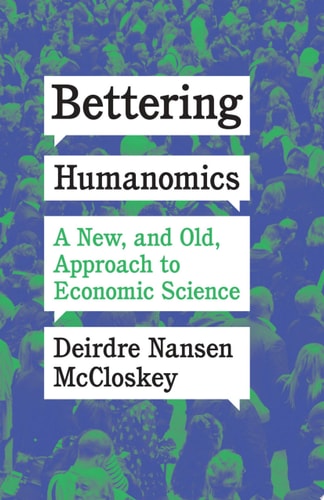
Bettering Humanomics: A New, and Old, Approach to Economic Science
0
0
As an Amazon Associate and affiliate partner, Menrva Books earns from qualifying purchases. Learn more
Author Description
Deirdre Nansen McCloskey's latest meticulous work examines how economics can become a more "human" science. Economic historian Deirdre Nansen McCloskey has distinguished herself through her writing on the Great Enrichment and the betterment of the poor—not just materially but spiritually. In Bettering Humanomics she continues her intellectually playful yet rigorous analysis with a focus on humans rather than the institutions. Going against the grain of contemporary neo-institutional and behavioral economics which privilege observation over understanding, she asserts her vision of “humanomics,” which draws on the work of Bart Wilson, Vernon Smith, and most prominently, Adam Smith. She argues for an economics that uses a comprehensive understanding of human action beyond behaviorism. McCloskey clearly articulates her points of contention with believers in “imperfections,” from Samuelson to Stiglitz, claiming that they have neglected scientific analysis in their haste to diagnose the ills of the system. In an engaging and erudite manner, she reaffirms the global successes of market-tested betterment and calls for empirical investigation that advances from material incentives to an awareness of the human within historical and ethical frameworks. Bettering Humanomics offers a critique of contemporary economics and a proposal for an economics as a better human science.
Menrva's Summary
THE THESIS
This book proposes a new framework for economic science, termed 'humanomics,' that prioritizes human understanding over mere behavioral observation. The author, a distinguished economic historian, critiques contemporary economics for its focus on institutions and behaviorism, arguing that it neglects a comprehensive understanding of human action. Drawing on the works of Adam Smith, Vernon Smith, and Bart Wilson, the book advocates for an economics that integrates historical and ethical frameworks, moving beyond material incentives to recognize the human element within economic systems. It challenges prevailing economic theories by asserting that a deeper, more humanistic approach is essential for truly understanding and improving economic outcomes.
THE SCOPE MAP
- A critique of contemporary neo-institutional and behavioral economics.
- An exploration of 'humanomics' as an alternative economic framework.
- Analysis drawing on the works of Adam Smith, Vernon Smith, and Bart Wilson.
- Discussion of the Great Enrichment and the betterment of the poor.
- An argument for understanding human action beyond behaviorism.
- A reevaluation of market-tested betterment and its global successes.
- An emphasis on empirical investigation within historical and ethical contexts.
THE AUTHORITY PERSPECTIVE
The book is presented as a meticulous examination of how economics can evolve into a more human-centered science. It continues the author's established work on economic history and the improvement of human well-being. The author engages directly with prominent economic thinkers, offering a clear critique of current methodologies and proposing a more holistic approach. The work aims to foster a richer understanding of economic phenomena by centering the human experience within its analysis.
Page Count:
157
Publication Date:
2023-06-05
Publisher:
University of Chicago Press
ISBN-10:
022677144X
ISBN-13:
9780226771441
History
Philosophy
Economics
Non-Fiction
Community Tags
Other Editions(2)
Similar Books














