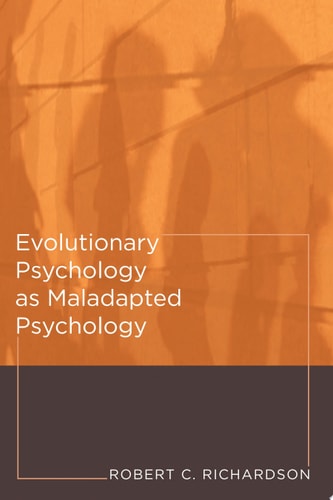
Evolutionary Psychology as Maladapted Psychology
0
0
As an Amazon Associate and affiliate partner, Menrva Books earns from qualifying purchases. Learn more
Author Description
A philosopher subjects the claims of evolutionary psychology to the evidential and methodological requirements of evolutionary biology, concluding that evolutionary psychology's explanations amount to speculation disguised as results. Human beings, like other organisms, are the products of evolution. Like other organisms, we exhibit traits that are the product of natural selection. Our psychological capacities are evolved traits as much as are our gait and posture. This much few would dispute. Evolutionary psychology goes further than this, claiming that our psychological traits—including a wide variety of traits, from mate preference and jealousy to language and reason—can be understood as specific adaptations to ancestral Pleistocene conditions. In Evolutionary Psychology as Maladapted Psychology, Robert Richardson takes a critical look at evolutionary psychology by subjecting its ambitious and controversial claims to the same sorts of methodological and evidential constraints that are broadly accepted within evolutionary biology. The claims of evolutionary psychology may pass muster as psychology; but what are their evolutionary credentials? Richardson considers three ways adaptive hypotheses can be evaluated, using examples from the biological literature to illustrate what sorts of evidence and methodology would be necessary to establish specific evolutionary and adaptive explanations of human psychological traits. He shows that existing explanations within evolutionary psychology fall woefully short of accepted biological standards. The theories offered by evolutionary psychologists may identify traits that are, or were, beneficial to humans. But gauged by biological standards, there is inadequate evidence: evolutionary psychologists are largely silent on the evolutionary evidence relevant to assessing their claims, including such matters as variation in ancestral populations, heritability, and the advantage offered to our ancestors. As evolutionary claims they
Menrva's Summary
THE THESIS
The book questions the scientific rigor of evolutionary psychology's claims about human psychological traits as adaptations to ancestral conditions. Robert C. Richardson, a philosopher, examines evolutionary psychology through the lens of evolutionary biology's methodological and evidential standards. He argues that many of evolutionary psychology's explanations, while potentially psychologically plausible, lack sufficient evolutionary grounding. The book scrutinizes the evidence required to establish adaptive hypotheses, using biological examples to highlight the shortcomings in current evolutionary psychology research regarding ancestral variation, heritability, and ancestral advantage.
THE SCOPE MAP
- An examination of evolutionary psychology's core claims regarding psychological traits as Pleistocene adaptations.
- A critique of evolutionary psychology's methodologies and evidential standards when compared to evolutionary biology.
- Analysis of three methods for evaluating adaptive hypotheses in evolutionary biology.
- Case studies illustrating the necessary evidence for establishing evolutionary and adaptive explanations of human psychological traits.
- An argument that evolutionary psychology's explanations often fall short of accepted biological standards.
- Discussion of the lack of evidence concerning ancestral population variation, heritability, and ancestral advantage in evolutionary psychology theories.
THE AUTHORITY PERSPECTIVE
This book is regarded as a rigorous philosophical critique of evolutionary psychology, specifically targeting its claims of adaptation. The author's approach is to apply the stringent evidential and methodological requirements of evolutionary biology to the theories proposed by evolutionary psychologists. It highlights that while evolutionary psychology may offer psychologically interesting hypotheses, their evolutionary credentials are often unsubstantiated by the necessary biological evidence. The work suggests that many of evolutionary psychology's conclusions remain speculative due to insufficient data on crucial factors like ancestral variation and heritability.
Page Count:
232
Publication Date:
2010-01-22
Publisher:
Random House Publishing Services
ISBN-10:
0262261111
ISBN-13:
9780262261111
Philosophy
Non-Fiction
Science & Technology
Psychology
Science
Evolutionary Biology
Methodology
Evolutionary Psychology
Community Tags
Other Editions(2)

Similar Books









Reader Comments
Share Your Thoughts
No comments yet. Be the first to share your thoughts!