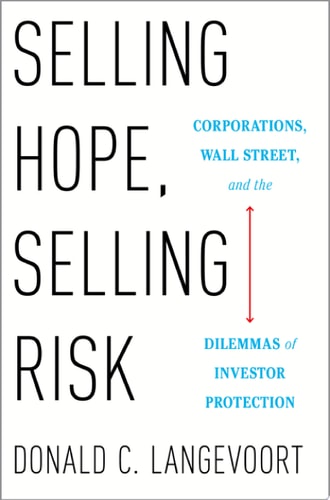
Selling Hope, Selling Risk
0
0
As an Amazon Associate and affiliate partner, Menrva Books earns from qualifying purchases. Learn more
Author Description
In The Midst Of Globalization, Technological Change, And Economic Anxiety, We Have Deep Doubts About How Well The Task Of Investor Protection Is Being Performed. In The U.s., The Focus Is On The Securities & Exchange Commission. Part Of The Explanation Is Economic And Political: The Failure To Know The Right Balance Between Investor Protection And Capital Formation, And The Resulting Battle Among Interest Groups Over Their Preferred Solutions. In Selling Hope, Selling Risk, Author Donald C. Langevoort Argues That Regulation Is Also Frustrated At Nearly Every Turn By Human Nature, As Exhibited Both On The Buy-side (investors) And Sell-side (corporate Executives, Bankers, Stockbrokers). There Is Plenty Of Savvy And Guile, But Also Ample Hope, Fear, Ego, Overconfidence, Social Contagion And The Like That Persistently Filter And Distort The Messages Regulators Try To Send. This Book Is The First Sustained Effort To Link The Key Initiatives Of Securities Regulation With Our Burgeoning Awareness In The Social Sciences Of How People And Organizations Really Behave In Economic Settings. It Examines Why Corporate Fraud Occurs And How Best To Deter It And Compensate Its Victims; The Search For An Edge Via Insider Trading; The Disclosure Apparatus And Its Gatekeepers; Sales Efforts And Manipulation In Ponzi Schemes, Internet Scams, Private Offerings And Crowdfunding; And How This All Helps Explain The Recent Global Financial Crisis. It Ends By Turning These Insights Back On The Task Of Regulation Itself, And The Strategies (and Frustrations) Of Making Regulation Work In A Financial World That Is At Once Increasingly Sophisticated Yet Deeply Human And Incurably Flawed.
Menrva's Summary
THE THESIS
This book investigates how human behavioral biases and psychological factors consistently undermine the efficacy of securities regulation and investor protection efforts. Donald C. Langevoort, a professor of law, synthesizes economic theory with social science research to explain why traditional regulatory frameworks often fail to curb corporate fraud and market manipulation. He argues that the inherent flaws in human decision-making—such as overconfidence, social contagion, and ego—create a persistent barrier that regulators struggle to overcome in an increasingly complex financial landscape.
THE SCOPE MAP
What You Will Find
- Analysis of behavioral economics applied to corporate executives, bankers, and investors.
- Examination of regulatory challenges regarding insider trading, disclosure requirements, and gatekeeper accountability.
- Case studies of financial misconduct, including Ponzi schemes, internet scams, and the global financial crisis.
Scope Limits
- The text focuses primarily on the United States regulatory environment and the Securities & Exchange Commission.
- It does not provide a comprehensive history of global financial markets, focusing instead on the intersection of psychology and regulation.
THE AUTHORITY PERSPECTIVE
Legal scholars and financial experts recognize this work as a foundational text for understanding the behavioral dimensions of securities law. Readers frequently note the academic density of the prose, which effectively bridges the gap between complex regulatory policy and psychological theory.
Page Count:
256
Publication Date:
2016-01-01
Publisher:
Oxford University Press
ISBN-10:
019022567X
ISBN-13:
9780190225674
Economics
Corporate Law
Business Ethics
Finance
Community Tags
Other Editions(2)

Similar Books