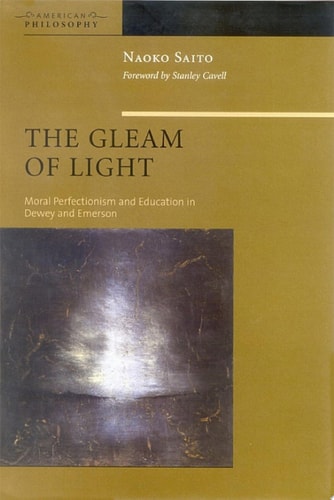
The Gleam of Light: Moral Perfectionism and Education in Dewey and Emerson
0
0
As an Amazon Associate and affiliate partner, Menrva Books earns from qualifying purchases. Learn more
Author Description
In the name of efficiency, the practice of education has come to be dominated by neoliberal ideology and procedures of standardization and quantification. Such attempts to make all aspects of practice transparent and subject to systematic accounting lack sensitivity to the invisible and the silent, to something in the human condition that cannot readily be expressed in an either-or form. Seeking alternatives to such trends, Saito reads Dewey's idea of progressive education through the lens of Emersonian moral perfectionism (to borrow a term coined by Stanley Cavell). She elucidates a spiritual and aesthetic dimension to Dewey's notion of growth, one considerably richer than what Dewey alone presents in his typically scientific terminology.The Gleam of Light: Moral Perfectionism and Education in Dewey and Emerson is available from the publisher on an open-access basis.
Menrva's Summary
THE THESIS
This book investigates the limitations of neoliberal ideology in education and proposes an alternative framework rooted in the philosophies of John Dewey and Ralph Waldo Emerson. The author, Naoko Saito, argues that current educational practices, driven by standardization and quantification, neglect the ineffable aspects of the human condition. By examining Dewey's concept of progressive education through the lens of Emersonian moral perfectionism, Saito uncovers a richer spiritual and aesthetic dimension to educational growth than is typically presented in Dewey's own scientific terminology.
THE SCOPE MAP
- Analysis of neoliberal ideology's dominance in contemporary education.
- Exploration of Dewey's progressive education through Emersonian moral perfectionism.
- Elucidation of a spiritual and aesthetic dimension to Dewey's concept of growth.
- Critique of standardization and quantification in educational practices.
- Focus on the 'invisible and the silent' aspects of the human condition in education.
- Discussion of Stanley Cavell's concept of moral perfectionism.
- Examination of the limitations of purely scientific terminology in educational discourse.
THE AUTHORITY PERSPECTIVE
The book is presented as an alternative to the prevailing neoliberal trends in education, seeking to reintroduce spiritual and aesthetic dimensions into pedagogical thought. By connecting Dewey's progressive education with Emerson's moral perfectionism, the work aims to offer a richer understanding of growth that transcends mere standardization and quantification. The author's approach highlights aspects of the human condition that are often overlooked in efficiency-driven educational systems. The book is made available by the publisher on an open-access basis.
Page Count:
228
Publication Date:
2018-09-18
Publisher:
Fordham University Press
ISBN-10:
0823283097
ISBN-13:
9780823283095
Philosophy
Non-Fiction
Education
History of Ideas
Community Tags
Similar Books