
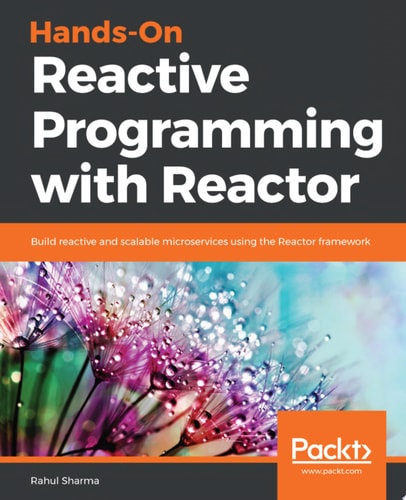
Hands-On Reactive Programming with Reactor
0
0
As an Amazon Associate and affiliate partner, Menrva Books earns from qualifying purchases. Learn more
Author Description
Discover how project Reactor enhances the reactive programming paradigm and allows you to build scalable asynchronous applications Key Features Use reactive APIs, Flux, and Mono to implement reactive extensions Create concurrent applications without the complexity of Java's concurrent API Understand techniques to implement event-driven and reactive applications Book Description Reactor is an implementation of the Java 9 Reactive Streams specification, an API for asynchronous data processing. This specification is based on a reactive programming paradigm, enabling developers to build enterprise-grade, robust applications with reduced complexity and in less time. Hands-On Reactive Programming with Reactor shows you how Reactor works, as well as how to use it to develop reactive applications in Java. The book begins with the fundamentals of Reactor and the role it plays in building effective applications. You will learn how to build fully non-blocking applications and will later be guided by the Publisher and Subscriber APIs. You will gain an understanding how to use two reactive composable APIs, Flux and Mono, which are used extensively to implement Reactive Extensions. All of these components are combined using various operations to build a complete solution. In addition to this, you will get to grips with the Flow API and understand backpressure in order to control overruns. You will also study the use of Spring WebFlux, an extension of the Reactor framework for building microservices. By the end of the book, you will have gained enough confidence to build reactive and scalable microservices. What you will learn Explore benefits of the Reactive paradigm and the Reactive Streams API Discover the impact of Flux and Mono implications in Reactor Expand and repeat data in stream processing Get to grips with various types of processors and choose the best on
Menrva's Summary
THE THESIS
This book investigates how Project Reactor, an implementation of the Java 9 Reactive Streams specification, can be leveraged to build scalable asynchronous applications. The author, Rahul Sharma, guides readers through the fundamentals of reactive programming and the Reactor framework, explaining its role in creating robust, enterprise-grade applications with reduced complexity. The book details the use of Publisher and Subscriber APIs, focusing on the composable Flux and Mono APIs for implementing Reactive Extensions and combining them with various operations to build complete solutions. It also covers the Flow API, backpressure for controlling overruns, and the application of Spring WebFlux for building microservices.
THE SCOPE MAP
- Fundamentals of Project Reactor and its role in asynchronous application development.
- Implementation of reactive extensions using Flux and Mono APIs.
- Techniques for building non-blocking, event-driven applications.
- Understanding and application of the Flow API and backpressure.
- Using Spring WebFlux for building reactive microservices.
- Benefits of the Reactive paradigm and the Reactive Streams API.
THE AUTHORITY PERSPECTIVE
This book is structured as a practical guide for developers looking to implement reactive programming in Java using Project Reactor. It covers essential concepts from the Reactive Streams specification, including the core Flux and Mono APIs, and extends to practical applications like Spring WebFlux for microservices. The content appears to be aimed at intermediate to advanced Java developers seeking to enhance their skills in building scalable, asynchronous systems.
Page Count:
250
Publication Date:
2018-09-29
Publisher:
Packt Publishing
ISBN-10:
1789135796
ISBN-13:
9781789135794
Non-Fiction
Science & Technology
Programming
Computer Science
Community Tags
Other Editions(2)
Similar Books








Reader Comments
Share Your Thoughts
No comments yet. Be the first to share your thoughts!