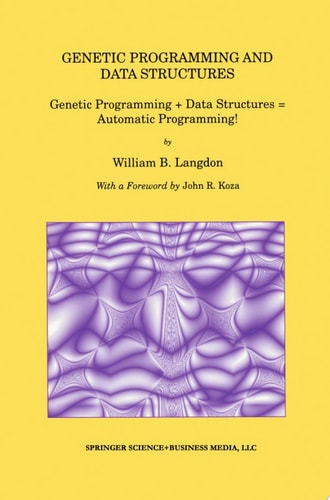
Genetic Programming and Data Structures: Genetic Programming + Data Structures = Automatic Programming!
0
0
As an Amazon Associate and affiliate partner, Menrva Books earns from qualifying purchases. Learn more
Author Description
Computers that `program themselves' has long been an aim of computer scientists. Recently genetic programming (GP) has started to show its promise by automatically evolving programs. Indeed in a small number of problems GP has evolved programs whose performance is similar to or even slightly better than that of programs written by people. The main thrust of GP has been to automatically create functions. While these can be of great use they contain no memory and relatively little work has addressed automatic creation of program code including stored data. This issue is the main focus of Genetic Programming, and Data Structures: Genetic Programming + Data Structures = Automatic Programming!. This book is motivated by the observation from software engineering that data abstraction (e.g., via abstract data types) is essential in programs created by human programmers. This book shows that abstract data types can be similarly beneficial to the automatic production of programs using GP. Genetic Programming and Data Structures: Genetic Programming + Data Structures = Automatic Programming! shows how abstract data types (stacks, queues and lists) can be evolved using genetic programming, demonstrates how GP can evolve general programs which solve the nested brackets problem, recognises a Dyck context free language, and implements a simple four function calculator. In these cases, an appropriate data structure is beneficial compared to simple indexed memory. This book also includes a survey of GP, with a critical review of experiments with evolving memory, and reports investigations of real world electrical network maintenance scheduling problems that demonstrate that Genetic Algorithms can find low cost viable solutions to such problems. Genetic Programming and Data Structures: Genetic Programming + Data Structures = Automatic Programming! should be of direct interest to computer scientists doing research on genetic programming, genetic algorithms, data struct
Menrva's Summary
THE THESIS
This book investigates the integration of data structures into genetic programming to achieve automatic programming. The author, William B. Langdon, addresses the long-standing goal of computer scientists to create self-programming computers. While genetic programming has shown promise in evolving functions, it has largely lacked the ability to incorporate memory or stored data, a crucial element in human-written software. This work focuses on demonstrating how abstract data types, such as stacks, queues, and lists, can be effectively evolved using genetic programming, thereby enhancing the capability of automatically generated programs.
THE SCOPE MAP
- Explores the evolution of programs using genetic programming with a focus on incorporating memory and stored data.
- Demonstrates the benefit of data abstraction, specifically abstract data types (stacks, queues, lists), in automatically produced programs.
- Presents case studies including the nested brackets problem, recognition of a Dyck context-free language, and implementation of a simple four-function calculator.
- Compares the effectiveness of abstract data types against simple indexed memory in GP applications.
- Includes a survey of genetic programming with a critical review of experiments in evolving memory.
- Reports on investigations into real-world electrical network maintenance scheduling problems using genetic algorithms.
THE AUTHORITY PERSPECTIVE
The book addresses a significant challenge in genetic programming: the automatic creation of programs that include data structures and memory. By focusing on abstract data types, it aims to bridge the gap between human programming practices and automated program synthesis. The research presented demonstrates practical applications and surveys existing work in evolving memory, suggesting a comprehensive approach to the topic. The inclusion of real-world problem-solving, such as maintenance scheduling, highlights the potential utility of these advanced genetic programming techniques.
Page Count:
279
Publication Date:
2012-12-06
Publisher:
Springer Science & Business Media
ISBN-10:
1461557313
ISBN-13:
9781461557319
Science
Non-Fiction
Programming
Machine Learning
Computer Science
Algorithms
Community Tags
Similar Books













Reader Comments
Share Your Thoughts
No comments yet. Be the first to share your thoughts!