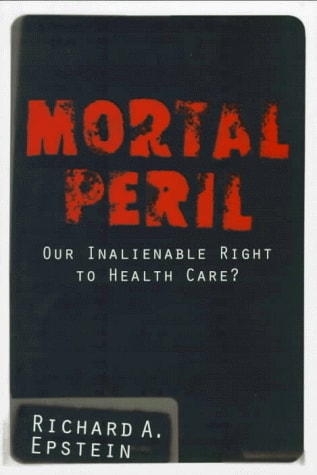
Mortal Peril: Our Inalienable Right To Health Care?
0
0
As an Amazon Associate and affiliate partner, Menrva Books earns from qualifying purchases. Learn more
Author Description
In this seminal work, distinguished legal scholar Richard Epstein daringly refutes the assumption that health care is a “right” that should be available to all Americans. Such thinking, he argues, has fundamentally distorted our national debate on health care by focusing the controversy on the unrealistic goal of government-provided universal access, instead of what can be reasonably provided to the largest number of people given the nation's limited resources.With bracing clarity, Epstein examines the entire range of health-care issues, from euthanasia and organ donation to the contentious questions surrounding access. Basing his argument in our common law traditions that limit the collective responsibility for an individual's welfare, he provides a political/economic analysis which suggests that unregulated provision of health care will, in the long run, guarantee greater access to quality medical care for more people. Any system, too, must be weighed on principles of market efficiency. But such analysis, in his view, must take into account a society-wide as well as an individual perspective. On this basis, for example, he concludes that older citizens are currently getting too much care at the expense of younger Americans.The author's authoritative analysis leads to strong conclusions. HMOs and managed care, he argues, are the best way we know to distribute health care, despite some damage to the quality of the physician-patient relationship and the risk of inadequate care. In a similar vein, he maintains that voluntary private markets in human organs would be much more effective in making organs available for transplant operations than the current system of state control. In examining these complex issues, Epstein returns again and again to one simple theme: by what right does the state prevent individuals from doing what they want with their own bodies, their own lives, and their own fortunes?Like all of Richard Epstein's works, Mortal Peril is sure to create c
Menrva's Summary
THE THESIS
Does the classification of health care as an inalienable right fundamentally distort the efficiency and accessibility of medical services in the United States? Richard A. Epstein, a prominent legal scholar, utilizes common law traditions and economic principles to challenge the prevailing assumption that universal government-provided health care is a viable or moral objective. He argues that the focus on rights-based rhetoric obscures the reality of limited resources, proposing instead that unregulated private markets and managed care systems offer superior outcomes for the population at large.
THE SCOPE MAP
What You Will Find
- Economic analysis of health care distribution and market efficiency.
- Legal arguments regarding individual autonomy versus state control over bodily and financial resources.
- Case studies on specific medical sectors including organ donation, euthanasia, and managed care organizations.
- A critical evaluation of intergenerational resource allocation and the role of HMOs in modern medicine.
THE AUTHORITY PERSPECTIVE
Readers frequently note the dense legal and economic reasoning that characterizes Epstein's prose. Experts often categorize this as a foundational text for those examining the intersection of libertarian legal theory and public health policy.
Page Count:
528
Publication Date:
1997-03-24
Publisher:
Basic Books
ISBN-10:
0201136473
ISBN-13:
9780201136470
Economics
Law
Public Policy
Right To Health
Community Tags
Similar Books