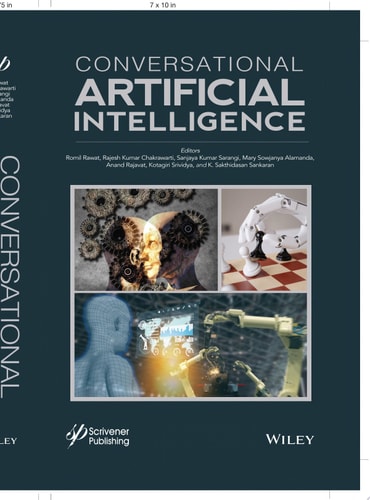
Conversational Artificial Intelligence
0
0
As an Amazon Associate and affiliate partner, Menrva Books earns from qualifying purchases. Learn more
Author Description
Conversational AI combines natural language processing (NLP) with traditional software like chatbots, voice assistants, or an interactive voice recognition system to help customers through either a spoken or typed interface. Conversational chatbots that respond to questions promptly and accurately to help customers are a fascinating development since they make the customer service industry somewhat self-sufficient. A well-automated chatbot can decimate staffing needs, but creating one is a time-consuming process. Voice recognition technologies are becoming more critical as AI assistants like Alexa become more popular. Chatbots in the corporate world have advanced technical connections with clients thanks to improvements in artificial intelligence. However, these chatbots’ increased access to sensitive information has raised serious security concerns. Threats are one-time events such as malware and DDOS (Distributed Denial of Service) assaults. Targeted strikes on companies are familiar and frequently lock workers out. User privacy violations are becoming more common, emphasizing the dangers of employing chatbots. Vulnerabilities are systemic problems that enable thieves to break in. Vulnerabilities allow threats to enter the system, hence they are inextricably linked. Malicious chatbots are widely used to spam and advertise in chat rooms by imitating human behavior and discussions, or to trick individuals into disclosing personal information like bank account details.
Menrva's Summary
THE THESIS
This book explores the multifaceted domain of Conversational Artificial Intelligence, detailing its core components, applications, and the evolving landscape of human-computer interaction. It examines how natural language processing (NLP) integrates with technologies like chatbots and voice assistants to enhance customer service and streamline business operations. The text also addresses the significant security and privacy challenges that arise with the increasing sophistication and access of these AI systems, including threats like malware, DDoS attacks, and user data breaches. Furthermore, it discusses the malicious uses of conversational AI, such as spamming and phishing, highlighting the critical need for robust security measures.
THE SCOPE MAP
- Definition and core components of Conversational AI, including NLP, chatbots, and voice assistants.
- Applications of Conversational AI in customer service and business operations.
- The process and challenges of developing effective automated chatbots.
- The growing importance of voice recognition technologies and AI assistants.
- Advancements in AI for corporate client interactions.
- Security concerns related to chatbots, including malware and DDoS attacks.
- Systemic vulnerabilities and their exploitation.
- Malicious uses of chatbots for spam, advertising, and phishing.
THE AUTHORITY PERSPECTIVE
The book delves into the technical and practical aspects of Conversational AI, offering insights into its development and deployment. It highlights the dual nature of this technology, showcasing its potential to revolutionize customer service while also underscoring the critical security and privacy risks involved. The discussion on vulnerabilities and malicious applications suggests a comprehensive approach to understanding the complete ecosystem of conversational agents. This work appears to be aimed at professionals and students interested in the current state and future challenges of AI in communication.
Page Count:
800
Publication Date:
2024-01-30
Publisher:
Wiley Global Research (STMS)
ISBN-10:
1394200781
ISBN-13:
9781394200788
Science & Technology
Business
Non-Fiction
Computer Science
Privacy
Customer service
Cybersecurity
Technology
Community Tags
Similar Books