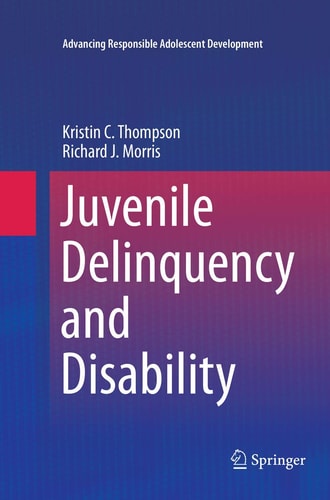
Juvenile Delinquency and Disability
0
0
As an Amazon Associate and affiliate partner, Menrva Books earns from qualifying purchases. Learn more
Author Description
This book discusses the relationship between juvenile disability and delinquency, including characteristics of youth with disabilities, how disability relates to delinquency, and its impact during a youth’s involvement with the juvenile justice system. The book details the relationship between developmental, cognitive, psychological, and educational disorders—specific conditions including ADHD, bipolar disorder, and autism spectrum disorder—and delinquency in light of both their overrepresentation among youth offenders and the uninformed handling of these youth within the court system. Case studies illustrate the complexities in the processing and placement of these youth offenders, as well as highlight the barriers to delinquent youth receiving appropriate treatment, and their increased risk of reoffending. From this robust knowledge base, the authors make expert recommendations for improving the juvenile justice system at the practice and policy levels to better serve this population. This authoritative volume: • Identifies characteristics and risk factors associated with juvenile delinquency. • Reviews evidence relating developmental, mental health, and other disorders to juvenile offending. • Describes the implications of disabilities in key areas such as offending, risk assessment, competency, and outcomes. • Examines the role of disability law in the juvenile justice system. • Offers guidelines for professionals to use this knowledge in their work. Juvenile Delinquency and Disability is an essential resource for researchers, scientist-practitioners, and graduate students in clinical, counseling, and school psychology, criminology and criminal justice, child psychiatry, educational policy and politics, developmental psychology, and social work.
Menrva's Summary
THE THESIS
This book investigates the complex intersection of juvenile disability and delinquency within the justice system. It examines the characteristics of youth with disabilities, how their conditions relate to offending behaviors, and the challenges they face when interacting with the juvenile justice system. The authors detail the connections between developmental, cognitive, psychological, and educational disorders, including ADHD, bipolar disorder, and autism spectrum disorder, and delinquency, noting both their overrepresentation among young offenders and the system's inadequate handling of these cases.
THE SCOPE MAP
- Identification of characteristics and risk factors associated with juvenile delinquency.
- Review of evidence linking developmental, mental health, and other disorders to juvenile offending.
- Description of the implications of disabilities in areas such as offending, risk assessment, competency, and outcomes.
- Examination of the role of disability law within the juvenile justice system.
- Guidelines for professionals to apply this knowledge in their practice.
THE AUTHORITY PERSPECTIVE
This authoritative volume is designed as an essential resource for researchers and practitioners across multiple disciplines, including psychology, criminology, child psychiatry, and social work. The authors leverage a robust knowledge base to offer expert recommendations for improving the juvenile justice system at both practice and policy levels. The book's structure, which includes case studies and clear guidelines, suggests a practical and evidence-based approach to understanding and addressing the needs of this vulnerable population. Its comprehensive scope aims to equip professionals with the necessary insights to better serve youth with disabilities involved in the justice system.
Page Count:
256
Publication Date:
2018-04-22
Publisher:
Springer International Publishing
ISBN-10:
3319805479
ISBN-13:
9783319805474
Psychology
Non-Fiction
Crime
Law
Special Education
Criminology
Social Work
Community Tags
Other Editions(3)
Similar Books









Reader Comments
Share Your Thoughts
No comments yet. Be the first to share your thoughts!