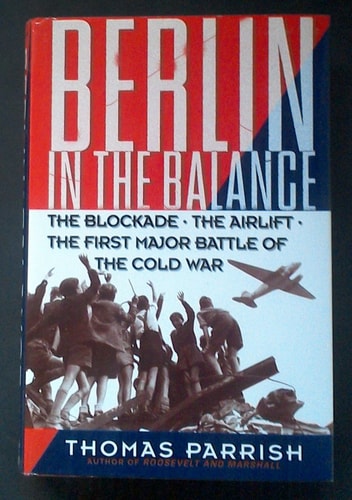
Berlin in the Balance: The Blockade, the Airlift, the First Major Battle of the Cold War
0
0
As an Amazon Associate and affiliate partner, Menrva Books earns from qualifying purchases. Learn more
Author Description
In June 1948, Soviet authorities in Germany announced a land blockade of the American, British, and French sectors of Berlin. Isolated more than one hundred miles within Soviet-occupied territory, western Berlin was in danger of running out of coal, food, and the courage to stand up to Joseph Stalin.As Berlin in the Balance recounts, this crisis was a turning-point for U.S. policy. Just three years earlier, the Soviet Union had been an ally and Berlin the target of American bombers. In 1946 Winston Churchill had ignited protests by calling for an Anglo-American alliance against the USSR. The Berlin blockade made Churchill's ”iron curtain” through Europe an inescapable reality.Led by Harry S. Truman, the Western Allies refused to back away from Berlin. Instead, they took to the air, packing passenger planes with coal, potatoes, flour, and other necessities. Not even the commanders of the year-old U.S. Air Force believed this fleet could supply western Berlin for long. Its main airport was squeezed among apartment buildings. Autumn would bring blinding fogs. And nobody had ever tried to supply a city of millions by air. Berlin in the Balance tells the full, gripping story of this critical conflict—how it developed and how it played out. Noted historian Thomas Parrish shows us the crisis through the eyes of Truman, Stalin, and other leaders. We hear Berliners cheer the arrival of each ”raisin bomber”; the planes' roar was assurance that the democratic powers had not abandoned them. Through sources made available only after the fall of the USSR, we learn how Soviet leaders planned their strategy to drive out the West, what they feared, and what they hoped to achieve. Berlin in the Balance spotlights a different kind of air force heroism—flying heavy transport planes in weather so bad ”the birds walked,” harassed by Soviet fighters but never firing a shot. Under the decisive leadership of General William H. Tunner, crews took off every three minutes around the clock.
Menrva's Summary
THE THESIS
This book investigates how the 1948 Berlin Blockade served as the definitive turning point in the early Cold War, forcing a shift in Western policy from wartime alliance to containment. Thomas Parrish, a noted historian, utilizes newly declassified Soviet archives and primary source accounts to reconstruct the geopolitical standoff between the United States and the Soviet Union. He argues that the success of the Berlin Airlift was not merely a logistical feat, but a psychological victory that solidified the division of Europe and established the framework for long-term democratic resistance against Soviet expansionism.
THE SCOPE MAP
What You Will Find
- Detailed analysis of the 1948-1949 Berlin Blockade and the subsequent Allied airlift operations.
- Examination of the strategic decision-making processes of Harry S. Truman and Joseph Stalin.
- Integration of post-Soviet archival data revealing internal Soviet planning and fears during the crisis.
- Technical accounts of the logistical challenges faced by the U.S. Air Force in supplying a city of millions by air.
THE AUTHORITY PERSPECTIVE
Historians and readers frequently cite this work as a comprehensive and accessible account of the logistical and political complexities of the Berlin Airlift. Experts highlight the book's effective use of newly available Soviet sources to provide a balanced view of the crisis from both sides of the Iron Curtain.
Page Count:
394
Publication Date:
1998-06-24
Publisher:
Addison-Wesley
ISBN-10:
0201258323
ISBN-13:
9780201258325
History
Cold War
Political History
20th Century
United States
Military History
Community Tags
Similar Books