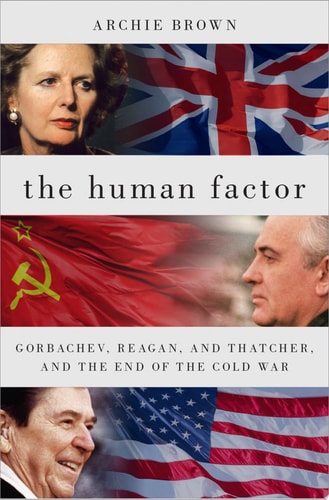
The Human Factor: Gorbachev, Reagan, and Thatcher, and the End of the Cold War
0
0
As an Amazon Associate and affiliate partner, Menrva Books earns from qualifying purchases. Learn more
Author Description
Intro -- Halftitle Page -- Books By The Same Author -- Title Page -- Copyright Page -- Contents -- Illustrations -- Abbreviations And Glossary -- Note On Terms And Transliteration -- Introduction -- Part I -- 1. The Cold War And Its Dangers -- The Communist Takeover Of Eastern Europe -- The Asian Battleground -- Change And Unrest In Eastern And Central Europe -- On The Verge Of Catastrophe -- 2. The Making Of Mikhail Gorbachev -- The 1940s -- Moscow University -- Back To Stavropol -- 3. Gorbachev's Widening Horizons -- New Vistas -- Five Hours With 'the Iron Lady' Gorbachev's Thinking On The Eve Of Perestroika -- 4. The Rise Of Ronald Reagan -- Hollywood -- Politics Beckons -- 5. Reagan's First Term -- New Broom At The State Department -- 'evil Empire' And Sdi -- A Shift Of Personnel And Of Priorities -- Mixed Signals -- 6. Margaret Thatcher: The Moulding Of The 'iron Lady' -- Foreign Policy Influences -- Early Years Of The Thatcher Premiership -- Falklands War And Relations With Reagan -- 7. Thatcher And The Turn To Engagement With Communist Europe -- A 'new Policy' -- Ups And Downs Of The Relationship With Reagan -- Part Ii -- 8. Breaking The Ice (1985) Stereotypes And Realities -- Tensions Within The Three Governments -- Approaches To The Summit -- Geneva, November 1985 -- 9. Nuclear Fallout Chernobyl And Reykjavik (1986) -- New People And New Thinking In Moscow -- Chernobyl And Its Impact -- Reagan Administration Wrangles Over Soviet Policy -- Reykjavik -- Reaction To Reykjavik In Moscow, Washington, And London -- 10. Building Trust (1987) -- Putting Political Reform On The Soviet Agenda -- Thatcher And The Puzzle Of Perestroika -- Thatcher's 'most Fascinating And Most Important Foreign Visit' Shultz's Battles In Washington And Progress In Moscow -- Shoring Up The Domestic Base-gorbachev And Reagan -- The Washington Summit -- 11. The End Of The Ideological Divide (1988) -- Intra-elite Differences In Moscow -- Harmonizing Western Approaches -- Reagan In Moscow --
Menrva's Summary
THE THESIS
This work investigates how the personal agency and evolving political philosophies of Mikhail Gorbachev, Ronald Reagan, and Margaret Thatcher facilitated the peaceful conclusion of the Cold War. Archie Brown, a distinguished political scientist and expert on Soviet politics, utilizes extensive archival research and personal interviews to argue that individual leadership styles and interpersonal diplomacy were as critical to geopolitical shifts as structural economic factors. The book examines the transition from ideological confrontation to pragmatic engagement, detailing how these three leaders navigated domestic pressures and international skepticism to dismantle the bipolar world order.
THE SCOPE MAP
What You Will Find
- Detailed analysis of the political maturation of Gorbachev, Reagan, and Thatcher prior to their respective tenures.
- A chronological account of key summits and diplomatic milestones from 1985 to 1988.
- Examination of the internal bureaucratic conflicts within the Soviet, American, and British governments.
- Primary source insights into the shifting perceptions of 'perestroika' and nuclear disarmament.
Scope Limits
- The narrative concludes primarily with the events of 1988 and does not provide an exhaustive account of the post-Soviet transition.
- The text focuses heavily on the interactions between these three specific leaders, offering less detail on the roles of other global actors or secondary nations.
THE AUTHORITY PERSPECTIVE
Historians and political scientists frequently cite this text as a definitive account of the interpersonal dynamics that defined the late Cold War era. Readers often note the academic rigor and depth of the prose, which balances high-level policy analysis with nuanced character studies of the three central figures.
Page Count:
448
Publication Date:
2020-01-01
Publisher:
Oxford University Press,
ISBN-10:
0190614900
ISBN-13:
9780190614904
History
Biography
Modern History
Political Leadership
Thatcher Margaret
Military History
Cold War
20th Century
American History
International relations
Community Tags
Similar Books