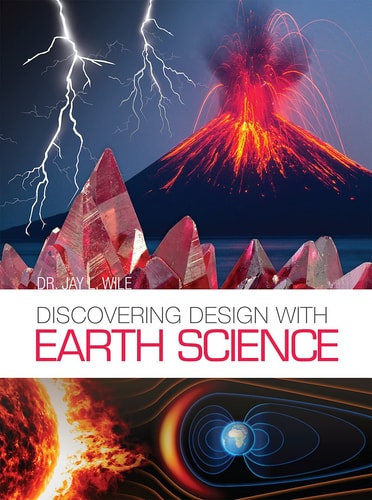
Discovering Design with Earth Science
0
0
As an Amazon Associate and affiliate partner, Menrva Books earns from qualifying purchases. Learn more
Author Description
This laboratory-based earth science course can be used for either eighth or ninth grade. Most homeschooled students should be ready for it in eighth grade, but privately- and publicly-schooled students will be more comfortable with it in ninth grade. It covers the general properties of the earth’s geosphere, hydrosphere, and atmosphere. Students learn about all the sections of the geosphere (such as core, mantle, crust, etc.) and then they study each in more detail. When studying the earth’s crust, they learn about minerals, rocks, and the rock cycle. Plate tectonics is then covered, which leads to a discussion of seismic waves, earthquakes, and volcanoes. Students then learn about fossils and how both uniformitarians and catastrophists interpret those fossils as well as the sedimentary rocks in which they are found. A discussion that compares uniformitarianism and catastrophism follows, in which the strengths and weaknesses of each view are covered. After that, the hydrosphere is discussed. Students first learn the properties of water such as polarity, the ability to hydrogen bond, and heat capacity. That leads to a discussion of the hydrologic cycle and residence time. Students then learn about the waves, currents, and tides in the ocean. They then move on to the ice reservoirs on the earth and then the freshwater reservoirs. Water in the air is the last part of the hydrosphere that is covered. The atmosphere is then discussed, including the composition of air, the sections of the atmosphere, temperature gradients, and pollutants. This leads to a discussion of weather. The course ends with two chapters on space, one that covers the solar system and one that covers the universe as a whole. There are roughly 55 hours of laboratory instruction in the course. A kit that contains specific minerals, rocks, and fossils allows students to do very detailed experiments related to the geosphere. These include mineral tests, rock analyses, fossil studies, d
Menrva's Summary
THE THESIS
This laboratory-based earth science course investigates the fundamental properties of Earth's geosphere, hydrosphere, and atmosphere. The curriculum is designed for eighth or ninth graders, covering detailed aspects of the Earth's interior, crustal components like minerals and rocks, plate tectonics, seismic activity, and volcanic phenomena. It also explores the interpretation of fossils and sedimentary rocks through the lenses of uniformitarianism and catastrophism, before delving into the properties of water, the hydrologic cycle, oceanography, and various water reservoirs. The course concludes with an examination of the atmosphere, weather patterns, the solar system, and the universe.
THE SCOPE MAP
- Detailed study of the geosphere, including core, mantle, crust, minerals, rocks, and the rock cycle.
- Exploration of plate tectonics, seismic waves, earthquakes, and volcanoes.
- Analysis of fossils and sedimentary rocks, comparing uniformitarian and catastrophist interpretations.
- In-depth coverage of the hydrosphere, including water properties, the hydrologic cycle, oceanography, and ice/freshwater reservoirs.
- Examination of the atmosphere, its composition, layers, temperature gradients, pollutants, and weather phenomena.
- Two concluding chapters dedicated to the solar system and the universe.
- Approximately 55 hours of laboratory instruction with a kit for hands-on experiments.
THE AUTHORITY PERSPECTIVE
This curriculum is structured to provide a comprehensive overview of Earth science, suitable for middle school or early high school students. The detailed breakdown of topics suggests a thorough pedagogical approach, integrating theoretical concepts with practical laboratory work. The inclusion of contrasting scientific interpretations, such as uniformitarianism and catastrophism, indicates an aim to foster critical thinking about scientific evidence and theory. The course concludes with broader astronomical topics, suggesting a holistic view of Earth's place in the cosmos.
Page Count:
552
Publication Date:
2021-01-01
Publisher:
Berean Builders
ISBN-10:
0996278435
ISBN-13:
9780996278430
Science
Non-Fiction
Astronomy
Curriculum
Education
Geology
Meteorology
Earth Science
Community Tags
Similar Books