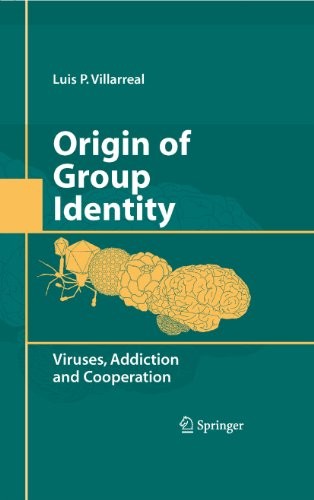
Origin of Group Identity: Viruses, Addiction and Cooperation
0
0
As an Amazon Associate and affiliate partner, Menrva Books earns from qualifying purchases. Learn more
Author Description
Author description coming soon. We're reaching out to them in the ether...
Menrva's Summary
THE THESIS
This book investigates the fundamental biological and social mechanisms that drive group identity formation, exploring the roles of viruses, addiction, and cooperation. The author, Luis P. Villarreal, draws upon his expertise in virology and evolutionary biology to propose a novel framework for understanding how these seemingly disparate elements converge to shape collective behavior and social structures. The work examines the evolutionary advantages conferred by viral integration into host genomes and the neurobiological underpinnings of addiction as drivers of social bonding and group cohesion. It further analyzes the critical role of cooperation, both innate and learned, in solidifying group identity against external pressures.
THE SCOPE MAP
- Exploration of viral integration into host genomes as a mechanism for genetic inheritance and group identity.
- Analysis of addiction as a biological and social phenomenon that fosters group cohesion and shared experience.
- Examination of cooperation, from kin selection to reciprocal altruism, as a cornerstone of group formation and maintenance.
- Discussion of the interplay between biological predispositions (viruses, addiction) and social constructs (cooperation) in shaping collective identity.
- Presentation of a theoretical model integrating evolutionary biology, neuroscience, and sociology to explain group identity.
- Case studies and examples from human and animal societies to illustrate the proposed mechanisms.
THE AUTHORITY PERSPECTIVE
This work is positioned as a significant contribution to the interdisciplinary study of group identity, likely appealing to specialists in evolutionary biology, sociology, and psychology. Its theoretical framework, which links viral evolution and addiction to cooperative behaviors, suggests a dense and analytical approach to complex biological and social questions. The book is expected to offer a novel perspective for researchers and advanced students seeking to understand the deep biological roots of social organization.
Page Count:
639
Publication Date:
2008-01-01
ISBN-10:
0387779981
ISBN-13:
9780387779980
Science
Non-Fiction
Psychology
Evolutionary Biology
Addiction Studies
Sociology
Biology
Community Tags
Similar Books