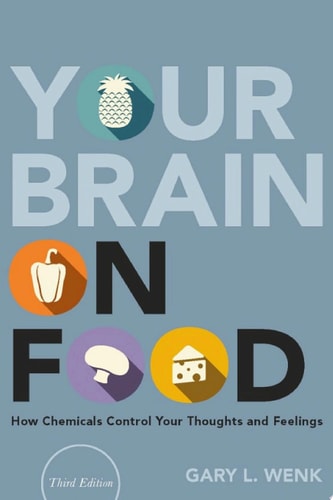
Your Brain on Food: How Chemicals Control Your Thoughts and Feelings
0
0
As an Amazon Associate and affiliate partner, Menrva Books earns from qualifying purchases. Learn more
Author Description
An internationally renowned neuroscientist, Dr. Wenk has been educating college and medical students about the brain and lecturing around the world for more than forty years. He has published over three hundred publications on the effects of drugs upon the brain. This essential book vividly demonstrates how a little knowledge about the foods and drugs we eat can teach us a lot about how our brain functions. The information is presented in an irreverent and non-judgmental manner that makes it highly accessible to high school teenagers, inquisitive college students and worried parents. Dr. Wenk has skillfully blended the highest scholarly standards with illuminating insights, gentle humor and welcome simplicity. The intersection between brain science, drugs, food and our cultural and religious traditions is plainly illustrated in an entirely new light. Wenk tackles fundamental questions, including:· Why do you wake up tired from a good long sleep and why does your sleepy brain crave coffee and donuts?· How can understanding a voodoo curse explain why it is so hard to stop smoking?· Why is a vegetarian or gluten-free diet not always the healthier option for the brain?· How can liposuction improve brain function? · What is the connection between nature's hallucinogens and religiosity?· Why does marijuana impair your memory now but protect your memory later in life?· Why do some foods produce nightmares? · What are the effects of diet and obesity upon the brains of infants and children?· Are some foods better to eat after traumatic brain injury?
Menrva's Summary
THE THESIS
This book investigates the complex biochemical relationship between the food we consume and the resulting impact on cognitive function, mood, and neurological health. Dr. Gary L. Wenk, a neuroscientist with over forty years of experience in brain research and pharmacology, utilizes his extensive academic background to explain how dietary choices and chemical intake modulate brain activity. He presents a framework that bridges the gap between rigorous scientific data and everyday eating habits, aiming to demystify how substances like caffeine, sugar, and various nutrients interact with neural pathways.
THE SCOPE MAP
What You Will Find
- Analysis of the neurochemical effects of common dietary staples like coffee, sugar, and gluten.
- Examination of the relationship between obesity, infant nutrition, and long-term brain development.
- Discussion on the intersection of cultural traditions, religious practices, and the consumption of psychoactive substances.
- Insights into how specific dietary interventions might support recovery after traumatic brain injury.
Scope Limits
- The text does not provide personalized medical advice or clinical treatment plans for specific neurological disorders.
- It does not serve as a comprehensive cookbook or a weight-loss manual.
THE AUTHORITY PERSPECTIVE
Experts and readers frequently note that the text successfully balances academic rigor with an accessible, irreverent tone that makes complex neurobiology understandable for a lay audience. It is widely regarded as a foundational resource for those interested in the physiological mechanisms behind dietary cravings and cognitive performance.
Page Count:
293
Publication Date:
2019-01-01
Publisher:
Oxford University Press
ISBN-10:
0190932813
ISBN-13:
9780190932817
Health
Science
Psychology
Allied Health
Neurochemistry
Medical
Nutrition
Neuroscience
Biology
Community Tags
Other Editions(2)

Similar Books