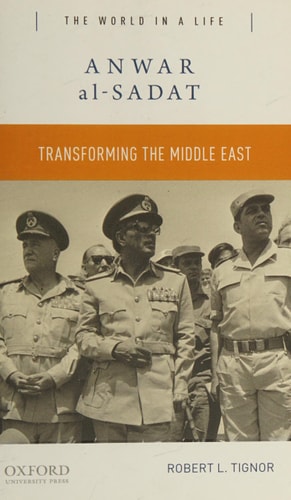
Anwar al-Sadat: Transforming the Middle East
0
0
As an Amazon Associate and affiliate partner, Menrva Books earns from qualifying purchases. Learn more
Author Description
Part of The World in a Life series, this brief, inexpensive text provides insight into the life of Anwar al-Sadat, one of the most transformative figures in Middle Eastern and world history. Little was expected of Sadat, as he came to power after the death of Egypt's powerful modernizing leader, Gamal Abdel Nasser. However, he left an unparalleled mark on Egypt, the Middle East, and Cold War relations. He surprised the Israelis by starting the 1973 war, crossing the Suez Canal into Sinai. Though eventually Egypt was forced to sue for peace, Sadat won the support and praise of the Americans. His chief American supporters at the time were President Richard Nixon and Secretary of State Henry Kissinger. Not content with this partial military success, Sadat traveled to Jerusalem in 1977 to address the Israeli Knesset (parliament), marking the first time that an Arab leader had traveled to Israel and openly negotiated with the Israelis. He followed this trip with a peace treaty with Israel in 1979, signed between Prime Minister Menachem Begin and himself and brokered by President Jimmy Carter. In short, Sadat broke Egypt's dependence on the Soviet Union, established strong relations with the United States, and recognized the state of Israel--all of these transformative events in Middle Eastern and world history.We live in a global age where big concepts like "globalization" often tempt us to forget the personal side of the past. The titles in The World in a Life series aim to revive these meaningful lives. Each one shows us what it was like to live on a world historical stage. Brief, inexpensive, and thematic, each book can be read in a week, fit within a wide range of curricula, and shed insight into a particular place or time. Four to six short primary sources at the end of each volume sharpen the reader's view of an individual's impact on world history.
Menrva's Summary
THE THESIS
How did Anwar al-Sadat fundamentally alter the geopolitical landscape of the Middle East and the trajectory of Egypt's foreign policy during the Cold War? Robert L. Tignor, a scholar of modern history, examines Sadat's transition from an underestimated successor to Gamal Abdel Nasser into a pivotal international actor. The text utilizes historical analysis to argue that Sadat's strategic pivots—specifically his shift from Soviet alignment to American partnership and his direct engagement with Israel—redefined regional power dynamics.
THE SCOPE MAP
What You Will Find
- Analysis of the 1973 Yom Kippur War and its diplomatic aftermath.
- Examination of the 1979 Egypt-Israel Peace Treaty.
- Contextualization of Cold War relations between Egypt, the Soviet Union, and the United States.
- Primary source documents providing firsthand accounts of Sadat's political maneuvers.
Scope Limits
- The text does not provide an exhaustive, multi-volume biography of Sadat's early life.
- It does not offer a comprehensive history of the entire Arab-Israeli conflict beyond Sadat's specific involvement.
THE AUTHORITY PERSPECTIVE
Experts and educators frequently identify this volume as a concise, accessible entry point for students studying 20th-century diplomacy. Readers note that the text maintains a high level of historical clarity while remaining brief enough for use in undergraduate curricula.
Page Count:
264
Publication Date:
2015-09-22
Publisher:
Oxford University Press
ISBN-10:
019024898X
ISBN-13:
9780190248987
History
Biography
Egypt - History
Middle Eastern
Egypt
Cold War
Community Tags
Similar Books