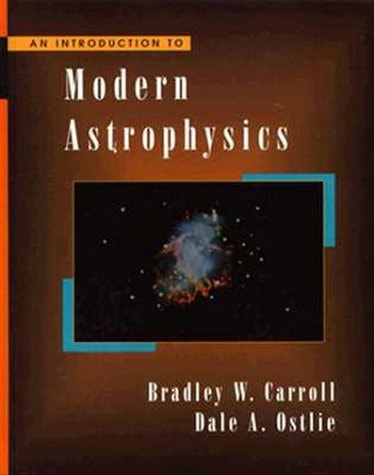
An Introduction to Modern Astrophysics
0
0
As an Amazon Associate and affiliate partner, Menrva Books earns from qualifying purchases. Learn more
Author Description
An Introduction to Modern Astrophysics, Second Edition has been thoroughly revised to reflect the dramatic changes and advancements in astrophysics that have occurred over the past decade. The Second Edition of this market-leading book has been updated to include the latest results from relevant fields of astrophysics and advances in our theoretical understanding of astrophysical phenomena.The Tools of Astronomy: The Celestial Sphere, Celestial Mechanics, The Continuous Spectrum of Light, The Theory of Special Relativity, The Interaction of Light and Matter, Telescopes; The Nature of Stars: Binary Systems and Stellar Parameters, The Classification of Stellar Spectra, Stellar Atmospheres, The Interiors of Stars, The Sun, The Process of Star Formation, Post-Main-Sequence Stellar Evolution, Stellar Pulsation, Supernovae, The Degenerate Remnants of Stars, Black Holes, Close Binary Star Systems; Planetary Systems: Physical Processes in the Solar System, The Terrestrial Planets, The Jovian Worlds, Minor Bodies of the Solar System, The Formation of Planetary Systems; Galaxies and the Universe: The Milky Way Galaxy, The Nature of Galaxies, Galactic Evolution, The Structure of the Universe, Active Galaxies, Cosmology, The Early Universe; Astronomical and Physical Constants, Unit Conversions Between SI and cgs, Solar System Data, The Constellations, The Brightest Stars, The Nearest Stars, Stellar Data, The Messier Catalog, Constants, A Constants Module for Fortran 95 (Available as a C++ header file), Orbits, A Planetary Orbit Code (Available as Fortran 95 and C++ command line versions, and Windows GUI), TwoStars, A Binary Star Code (Generates synthetic light and radial velocity curves; available as Fortran 95 and C++ command line versions, and Windows GUI), StatStar, A Stellar Structure Code (Available as Fortran 95 and C++ command line versions, and Windows GUI), StatStar, Stellar Models, Galaxy, A Tidal Interaction Code (Available as Java), WMAP Data. For all readers intere
Menrva's Summary
THE THESIS
This text investigates the fundamental physical principles governing the universe, from the mechanics of stellar evolution to the large-scale structure of cosmology. Bradley W. Carroll and Dale A. Ostlie, both distinguished professors of physics and astronomy, synthesize decades of observational data and theoretical physics to provide a comprehensive framework for understanding astrophysical phenomena. The book bridges the gap between introductory physics and advanced research, utilizing mathematical rigor to explain the life cycles of stars, the dynamics of planetary systems, and the evolution of galaxies.
THE SCOPE MAP
What You Will Find
- Comprehensive coverage of celestial mechanics, special relativity, and the interaction of light and matter.
- Detailed analysis of stellar interiors, atmospheres, and the processes of star formation and death.
- Examination of galactic evolution, active galaxies, and the structural development of the early universe.
- Practical computational tools including Fortran and C++ code modules for modeling stellar structures and binary star systems.
THE AUTHORITY PERSPECTIVE
Experts and educators widely recognize this work as a foundational, comprehensive text for undergraduate students pursuing degrees in physics or astronomy. Readers frequently note the significant academic density of the prose, which requires a solid background in calculus and classical mechanics to fully comprehend the material.
Page Count:
1326
Publication Date:
1995-12-11
Publisher:
Benjamin Cummings
ISBN-10:
0201547309
ISBN-13:
9780201547306
Science
Astrophysics
textbook
Astronomy
Physics
Community Tags
Similar Books