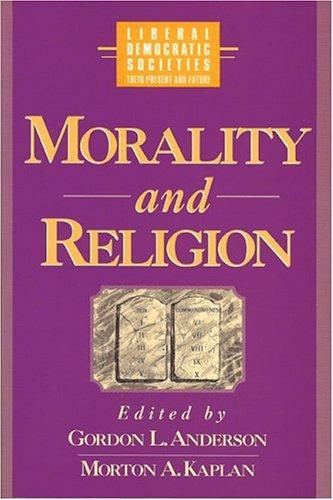
Morality and Religion in Liberal Democratic Societies
0
0
As an Amazon Associate and affiliate partner, Menrva Books earns from qualifying purchases. Learn more
Author Description
The struggle for liberal democracy, individual freedom, and human and political rights historically has depended upon the moral codes of Western civilization rooted in the Judeo-Christian tradition. However in an increasing pluralistic and secular world, those codes are difficult to maintain. Without a consensus on values and the exercise of individual responsibility, liberal democratic societies and the human and political values they enshrine may become imperilled. The problem of the relationship between morality and the liberal democratic state is examined in this volume from the perspectives of democratic theory, traditional religion, the modern state, and the evolution of religion in the post-communist world. In the first section, on democratic theory, professors R.A.D. Grant, David Levy, Michael Perry, and Morton A. Kaplan discuss the theoretical relationship between moral values and the democratic state. In the second section Gershon Weiler, Batista Jean Mondin, and Dean Kelley discuss the historical struggles of Judaism, Catholicism, and Protestantism with and within liberal democratic societies. The inconsistencies of many traditional religious perspectives with a culturally pluralistic society are examined. In the following section, A. James Reichley discusses the pluralist experiment in America; George Weigle sees a new opportunity for the Catholic Church in America; John Carroll discusses the tensions of modern liberalism with culture in general; and Alain Besancon discusses the Catholic church in Europe. Possibilities for the resolution of religious perspectives within pluralistic and liberal democratic societies are examined by scholars who want both to be faithful to their traditions and to integrate them into modern democracies. In the penultimate section of the book, Roger Scruton analyzes problems of sexual morality and identity and the liberal consensus; Geoffrey Partington discusses how the purge of traditional moral training from the public sc
Menrva's Summary
THE THESIS
This volume examines the complex and often fraught relationship between morality and religion within the framework of liberal democratic societies. The book investigates how the traditional moral codes, historically rooted in the Judeo-Christian tradition and essential for upholding individual freedom and human rights, face challenges in an increasingly pluralistic and secular world. It explores the potential imperilment of liberal democratic values and the exercise of individual responsibility when a consensus on values erodes. The work is structured to address these issues from multiple vantage points, including democratic theory, the historical experiences of various religious traditions, the nature of the modern state, and the evolution of religion in post-communist contexts.
THE SCOPE MAP
- Analysis of the theoretical relationship between moral values and the democratic state, featuring contributions from R.A.D. Grant, David Levy, Michael Perry, and Morton A. Kaplan.
- Historical examination of Judaism, Catholicism, and Protestantism's engagement with liberal democratic societies, including discussions by Gershon Weiler, Batista Jean Mondin, and Dean Kelley.
- Exploration of the inconsistencies between traditional religious perspectives and culturally pluralistic societies.
- Discussion of the American pluralist experiment by A. James Reichley.
- Examination of new opportunities for the Catholic Church in America by George Weigle.
- Analysis of the tensions between modern liberalism and general culture by John Carroll.
- Discussion of the Catholic Church in Europe by Alain Besancon.
- Scholarly perspectives on resolving religious perspectives within pluralistic and liberal democratic societies, aiming for faithfulness to tradition and integration into modern democracies.
THE AUTHORITY PERSPECTIVE
The book is structured as a collection of essays from various scholars, exploring the theoretical and historical intersections of morality, religion, and liberal democracy. The contributions are organized into distinct sections, each focusing on a specific aspect of this relationship, from democratic theory to the historical struggles of major religions within democratic frameworks. The scholars aim to reconcile traditional religious values with the demands of modern, pluralistic democracies. The volume appears to offer a multi-faceted academic inquiry into a critical societal challenge.
Page Count:
363
Publication Date:
1992-01-01
ISBN-10:
094385296X
ISBN-13:
9780943852966
Philosophy
Politics
Religion
Non-Fiction
Sociology
Community Tags
Similar Books