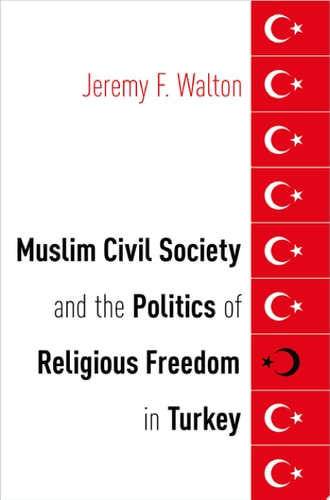
Muslim Civil Society and the Politics of Religious Freedom in Turkey (AAR Religion, Culture, and History)
0
0
As an Amazon Associate and affiliate partner, Menrva Books earns from qualifying purchases. Learn more
Author Description
The sway of Islam in political life is an unavoidable topic of debate in Turkey today. Secularists, Islamists, and liberals alike understand the Turkish state to be the primary arbiter of Islam's place in Turkey--as the coup attempt of July 2016 and its aftermath have dramatically illustrated. Yet this emphasis on the state ignores the influence of another field of political action in relation to Islam, that of civil society. Based on ethnographic research conducted in Istanbul and Ankara, Muslim Civil Society and the Politics of Religious Freedom in Turkey is Jeremy F. Walton's inquiry into the political and religious practices of contemporary Turkish-Muslim Nongovernmental Organizations. Since the mid-1980s, Turkey has witnessed an efflorescence of NGOs in tandem with a neoliberal turn in domestic economic policies and electoral politics. One major effect of this neoliberal turn has been the emergence of a vibrant Muslim civil society, which has decentered and transformed the Turkish state's relationship to Islam. Muslim NGOs champion religious freedom as a paramount political ideal and marshal a distinctive, nongovernmental politics of religious freedom to advocate this ideal. Walton's accomplished study offers a fine-grained perspective on this nongovernmental politics of religious freedom and the institutions and communities from which it emerges.
Menrva's Summary
THE THESIS
This book investigates how Muslim nongovernmental organizations in Turkey have redefined the relationship between the state, religion, and political agency. Jeremy F. Walton, an anthropologist, utilizes extensive ethnographic research conducted in Istanbul and Ankara to analyze the rise of Muslim NGOs since the mid-1980s. He argues that these organizations have established a distinct form of nongovernmental politics that challenges the traditional state-centric view of religious authority in Turkey.
THE SCOPE MAP
What You Will Find
- Analysis of the neoliberal turn in Turkish economic and electoral policy since the 1980s.
- Ethnographic case studies of specific Turkish-Muslim nongovernmental organizations.
- Examination of how religious freedom is conceptualized and mobilized as a political ideal.
Scope Limits
- The study focuses primarily on the period following the mid-1980s and does not provide a comprehensive history of the Ottoman or early Republican eras.
- The research is localized to Istanbul and Ankara and may not fully account for rural or peripheral regional dynamics.
THE AUTHORITY PERSPECTIVE
Scholars in the field of Middle Eastern studies and political sociology recognize this work as a significant contribution to understanding the intersection of neoliberalism and religious practice. Readers frequently note the academic density of the prose, which provides a rigorous framework for analyzing contemporary Turkish political life.
Page Count:
272
Publication Date:
2017-01-01
Publisher:
Oxford University Press
ISBN-10:
0190658991
ISBN-13:
9780190658991
Religion
Politics & Government
Middle Eastern
Cultural Anthropology
Sociology
Civil society
Turkey
Community Tags
Similar Books