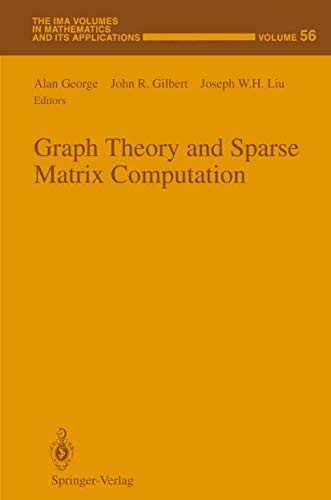
Graph Theory and Sparse Matrix Computation
0
0
As an Amazon Associate and affiliate partner, Menrva Books earns from qualifying purchases. Learn more
Author Description
When reality is modeled by computation, matrices are often the connection between the continuous physical world and the finite algorithmic one. Usually, the more detailed the model, the bigger the matrix, the better the answer, however, efficiency demands that every possible advantage be exploited. The articles in this volume are based on recent research on sparse matrix computations. This volume looks at graph theory as it connects to linear algebra, parallel computing, data structures, geometry, and both numerical and discrete algorithms. The articles are grouped into three general categories: graph models of symmetric matrices and factorizations, graph models of algorithms on nonsymmetric matrices, and parallel sparse matrix algorithms. This book will be a resource for the researcher or advanced student of either graphs or sparse matrices; it will be useful to mathematicians, numerical analysts and theoretical computer scientists alike.
Menrva's Summary
THE THESIS
The computational modeling of reality often relies on matrices, bridging the gap between continuous physical phenomena and discrete algorithmic processes. This volume explores recent research in sparse matrix computations, focusing on the intersection of graph theory with linear algebra, parallel computing, data structures, geometry, and both numerical and discrete algorithms. The articles are organized into three main sections: graph models for symmetric matrices and factorizations, graph models for algorithms on nonsymmetric matrices, and parallel sparse matrix algorithms. It is intended as a resource for researchers and advanced students in graph theory or sparse matrices, appealing to mathematicians, numerical analysts, and theoretical computer scientists.
THE SCOPE MAP
- Graph models of symmetric matrices and factorizations
- Graph models of algorithms on nonsymmetric matrices
- Parallel sparse matrix algorithms
- Applications of graph theory to linear algebra
- Connections to parallel computing and data structures
- Integration of geometric concepts
- Discussion of both numerical and discrete algorithms
THE AUTHORITY PERSPECTIVE
This book is positioned as a specialized resource for researchers and advanced students in the fields of graph theory and sparse matrices. Its content is likely to appeal to a niche audience within mathematics, numerical analysis, and theoretical computer science, suggesting a focus on technical depth and rigorous analysis. The organization into distinct categories indicates a structured approach to presenting complex topics. The collection of articles suggests a compilation of current research findings, aiming to advance the understanding and application of these computational techniques.
Page Count:
245
Publication Date:
1993-01-01
ISBN-10:
0387941312
Science
Non-Fiction
Graph Theory
Computer Science
Linear Algebra
Algorithms
Numerical analysis
Community Tags
Similar Books