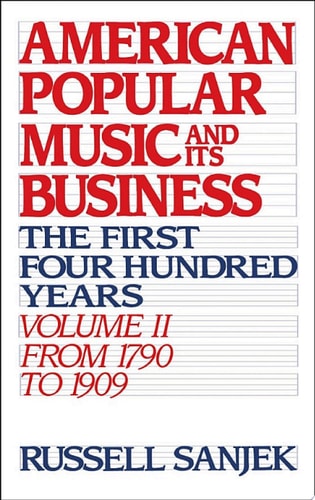
American Popular Music and Its Business: The First Four Hundred Years
0
0
As an Amazon Associate and affiliate partner, Menrva Books earns from qualifying purchases. Learn more
Author Description
Volume two concentrates exclusively on music activity in the United States in the nineteenth century. Among the topics discussed are how changing technology affected the printing of music, the development of sheet music publishing, the growth of the American musical theater, popular religious music, black music (including spirituals and ragtime), music during the Civil War, and finally "music in the era of monopoly," including such subjects as copyright, changing technology and distribution, invention of the phonograph, copyright revision, and the establishment of Tin Pan Alley.
Menrva's Summary
THE THESIS
This volume investigates the evolution of the American music industry throughout the nineteenth century, focusing on the intersection of technological advancement, commercial growth, and cultural shifts. The author, Russell Sanjek, provides a comprehensive examination of how the business of music transformed from localized printing and publishing into a centralized, monopolistic system. By analyzing the transition from sheet music to the early phonograph era, the text argues that the structural development of the industry was as significant as the music itself in shaping American culture.
THE SCOPE MAP
What You Will Find
- Analysis of nineteenth-century music publishing and printing technology
- Examination of the rise of American musical theater and popular religious music
- Historical overview of black music, including spirituals and ragtime
- Documentation of the impact of the Civil War on musical distribution
- Detailed study of copyright law, monopoly formation, and the birth of Tin Pan Alley
Scope Limits
- The text is limited to the nineteenth century and does not cover twentieth-century developments
- The focus remains primarily on the business and industrial aspects rather than music theory or composition
THE AUTHORITY PERSPECTIVE
Scholars and music historians frequently cite this work as a foundational resource for understanding the commercial infrastructure of nineteenth-century American music. Readers often note the dense, research-heavy nature of the prose, which provides a rigorous look at the economic forces that defined the era.
Page Count:
489
Publication Date:
1988-01-01
Publisher:
Oxford University Press
ISBN-10:
0190243295
ISBN-13:
9780190243296
Humanities
American History
Business History
Music Industry
Music History
Business Aspects
Community Tags
Similar Books