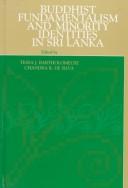
Buddhist Fundamentalism and Minority Identities in Sri Lanka
0
0
As an Amazon Associate and affiliate partner, Menrva Books earns from qualifying purchases. Learn more
Author Description
Buddhist Fundamentalism and Minority Identities in Sri Lanka explores Sinhala-Buddhist fundamentalist ideology and its power to shape the identities of Sri Lanka's ethnic and religious minorities. Sinhala-Buddhist fundamentalists in contemporary Sri Lanka share and ideology that asserts a vital link between the island of Sri Lanka and this Sinhala people, especially in their role as curators of Buddhism, and often at the exclusion of the minorities. Minority responses to Sinhala-Buddhist fundamentalism are manifold, ranging from assimilation to the formation of rival fundamentalisms. The authors provide views of history markedly different from most scholarly reflections on Sri Lanka; thus, the history of shifting perceptions of Sinhala-Buddhist fundamentalism offered here constitutes an important contribution to the subaltern history of Sri Lanka. By treating both the development of Sinhala-Buddhist fundamentalism in the late nineteenth century and its hegemony in the late twentieth, this study links the present to the past.
Menrva's Summary
THE THESIS
This book investigates the ideology of Sinhala-Buddhist fundamentalism and its impact on the identities of Sri Lanka's ethnic and religious minorities. The author examines how this ideology posits a crucial connection between the island of Sri Lanka and the Sinhala people, particularly in their role as guardians of Buddhism, often to the detriment of minority groups. It explores the diverse ways minorities have responded to this fundamentalism, including assimilation and the emergence of competing fundamentalist movements. The study links contemporary issues to historical developments, tracing the rise of Sinhala-Buddhist fundamentalism from the late nineteenth century to its dominance in the late twentieth century.
THE SCOPE MAP
- Analysis of Sinhala-Buddhist fundamentalist ideology.
- Exploration of its power to shape minority identities in Sri Lanka.
- Examination of minority responses, including assimilation and rival fundamentalisms.
- Historical perspective on the development of Sinhala-Buddhist fundamentalism from the late 19th century.
- Discussion of the hegemony of this ideology in the late 20th century.
- Contribution to the subaltern history of Sri Lanka through alternative historical viewpoints.
THE AUTHORITY PERSPECTIVE
The book offers a distinct historical perspective on Sri Lanka, focusing on the development and impact of Sinhala-Buddhist fundamentalism. It examines the complex interplay between dominant ideology and minority identity formation, providing insights into various minority responses. By connecting late 19th-century origins to late 20th-century hegemony, the study bridges historical periods to illuminate contemporary issues. The work contributes to understanding the subaltern history of Sri Lanka through its unique historical reflections.
Page Count:
212
Publication Date:
1998-01-01
ISBN-10:
0791438333
ISBN-13:
9780791438336
Non-Fiction
Religion
Politics
History
Sociology
Community Tags
Similar Books