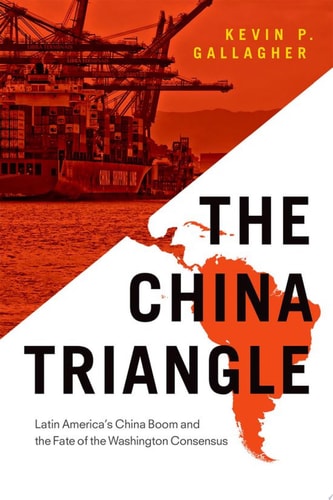
The China Triangle: Latin America's China Boom and the Fate of the Washington Consensus
0
0
As an Amazon Associate and affiliate partner, Menrva Books earns from qualifying purchases. Learn more
Author Description
Since 1980, China has evolved from a poor and mostly rural society into one of the largest economies in the world. As it grew into a major industrial power, it demanded enormous amounts of steel for new factories and cities, copper for electronic wires, petroleum for cars and manufacturing plants, and soybeans and cattle to feed its workers. By the 1990s, many Latin American countries were riding China's coattails and beginning to prosper from the new demand. Ever since China entered the World Trade Organization at the turn of the century, Latin America supplied China with more and more of the primary commodities it needs and more. That in turn has produced one the most impressive periods of economic growth on the continent in fifty years. And it was more evenly spread too - a region infamous for its extreme inequality saw it decline by a couple of percentage points over the course of the era.In The China Triangle, Kevin P. Gallagher traces the development of the China-Latin America trade over time and covers how it has affected the centuries-old (and highly unequal) US-Latin American relationship. He argues that despite these opportunities Latin American nations have little to show for riding the coattails of the 'China Boom' and now face significant challenges in the next decades as China's economy slows down and shifts more toward consumption and services. While the Latin American region saw significant economic growth due to China's rise over the past decades, Latin Americans saved very little of the windfall profits it earned even as the region saw a significant hollowing of its industrial base. What is more, commodity-led growth during the China boom reignited social and environmental conflicts across the region.Scholars and reporters have covered the Chinese expansion into East Asia, Southeast Asia, Australasia, Africa, the US, and Europe. Yet China's penetration Latin America is as little understood as it is significant-especially for America given its longs
Menrva's Summary
THE THESIS
This book investigates whether the economic windfall from China's rapid industrialization has provided Latin American nations with sustainable development or merely reinforced historical dependencies. Kevin P. Gallagher, a professor of global development policy, utilizes trade data and economic analysis to examine the shifting dynamics of the 'China Boom.' He argues that while the region experienced short-term growth, the failure to reinvest profits and the resulting hollowing of local industrial bases have left these nations vulnerable to China's economic transition.
THE SCOPE MAP
What You Will Find
- Analysis of trade patterns between China and Latin American countries since the 1990s.
- Examination of the impact of commodity-led growth on regional inequality and environmental stability.
- Assessment of the evolving trilateral relationship between China, Latin America, and the United States.
Scope Limits
- The text focuses primarily on macroeconomic trade trends rather than granular micro-level case studies of individual corporate entities.
- It does not provide a comprehensive forecast of future Chinese diplomatic policy beyond economic trade implications.
THE AUTHORITY PERSPECTIVE
Experts recognize this work as a critical contribution to understanding the geopolitical and economic shifts in the Western Hemisphere. Readers frequently note the academic rigor of the prose and the author's ability to synthesize complex trade data into a coherent narrative regarding regional development.
Page Count:
256
Publication Date:
2016-03-21
Publisher:
Oxford University Press
ISBN-10:
0190246731
ISBN-13:
9780190246730
Economics
United States
Trade Policy
Comparative Politics
Globalization
China
International relations
American Studies
Community Tags
Similar Books