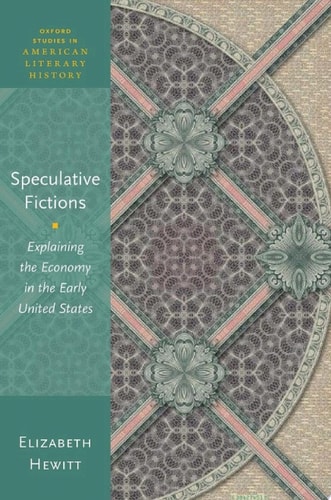
Speculative Fictions: Explaining the Economy in the Early United States
0
0
As an Amazon Associate and affiliate partner, Menrva Books earns from qualifying purchases. Learn more
Author Description
Speculative Fictions places Alexander Hamilton at the center of American literary history to consider the important intersections between economics and literature. By studying Hamilton as an economic and imaginative writer, it argues that we can recast the conflict with the Jeffersonians as a literary debate about the best way to explain and describe modern capitalism, and explores how various other literary forms allow us to comprehend the complexities of a modern global economy in entirely new ways. Speculative Fictions identifies two overlooked literary genres of the late eighteenth-century as exemplary of this narrative mode. It asks that we read periodical essays and Black Atlantic captivity narratives with an eye not towards bourgeois subject formation, but as descriptive analyses of economic systems. In doing so, we discover how these two literary genres offer very different portraits of a global economy than that rendered by the novel, the imaginative genre we are most likely to associate with modern capitalism. Developing an aesthetic appreciation for the speculative, digressive, and unsystematic plotlines of these earlier narratives has the capacity to generate new imaginative projects with which to make sense of our increasingly difficult economic world.
Menrva's Summary
THE THESIS
This work investigates how early American economic thought and literary form intersected to shape the nation's understanding of modern capitalism. Elizabeth Hewitt, a scholar of American literary history, utilizes the writings of Alexander Hamilton and his contemporaries to argue that economic discourse was fundamentally an imaginative project. She posits that the conflict between Hamilton and the Jeffersonians was not merely political, but a literary disagreement over the most effective methods for describing and explaining the emerging global economic system.
THE SCOPE MAP
What You Will Find
- Analysis of Alexander Hamilton's economic and imaginative writing styles
- Examination of late eighteenth-century periodical essays and Black Atlantic captivity narratives
- A comparative study of economic representation in novels versus non-novelistic genres
- Theoretical framework for reading economic systems through narrative structure
Scope Limits
- Does not provide a comprehensive history of the American economy
- Does not focus on the standard novelistic tradition of the nineteenth century
THE AUTHORITY PERSPECTIVE
Scholars frequently cite this text for its interdisciplinary approach to early American history and economic theory. Experts highlight the author's ability to reframe canonical political figures through the lens of literary aesthetics and narrative analysis.
Page Count:
344
Publication Date:
2020-01-01
Publisher:
OUP Oxford
ISBN-10:
0192602993
ISBN-13:
9780192602992
History
Economics
English & College Success
English
Literary Criticism
American Studies
Community Tags
Other Editions(3)
Similar Books