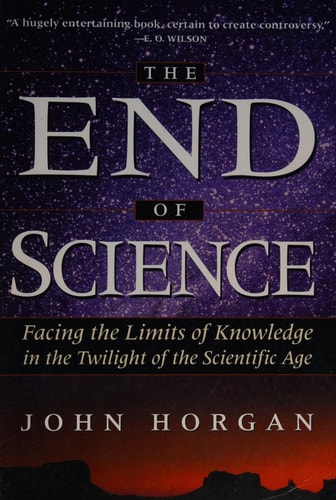
The End of Science: Facing the Limits of Knowledge in the Twilight of the Scientific Age
0
0
As an Amazon Associate and affiliate partner, Menrva Books earns from qualifying purchases. Learn more
Author Description
As staff writer for Scientific American, John Horgan has a window on contemporary science unsurpassed in all the world. Who else routinely interviews the likes of Lynn Margulis, Roger Penrose, Francis Crick, Richard Dawkins, Freeman Dyson, Murray Gell-Mann, Stephen Jay Gould, Stephen Hawking, Thomas Kuhn, Chris Langton, Karl Popper, Stephen Weinberg, and E.O. Wilson, with the freedom to probe their innermost thoughts?In The End Of Science, Horgan displays his genius for getting these larger-than-life figures to be simply human, and scientists, he writes, ”are rarely so human...so at ther mercy of their fears and desires, as when they are confronting the limits of knowledge.”This is the secret fear that Horgan pursues throughout this remarkable book: Have the big questions all been answered? Has all the knowledge worth pursuing become known? Will there be a final ”theory of everything” that signals the end? Is the age of great discoverers behind us? Is science today reduced to mere puzzle solving and adding detains to existing theories?Horgan extracts surprisingly candid answers to there and other delicate questions as he discusses God, Star Trek, superstrings, quarks, plectics, consciousness, Neural Darwinism, Marx's view of progress, Kuhn's view of revolutions, cellular automata, robots, and the Omega Point, with Fred Hoyle, Noam Chomsky, John Wheeler, Clifford Geertz, and dozens of other eminent scholars. The resulting narrative will both infuriate and delight as it mindles Horgan's smart, contrarian argument for ”endism” with a witty, thoughtful, even profound overview of the entire scientific enterprise.Scientists have always set themselves apart from other scholars in the belief that they do not construct the truth, they discover it. Their work is not interpretation but simple revelation of what exists in the empirical universe. But science itself keeps imposing limits on its own power. Special relativity prohibits the transmission of matter or information as s
Menrva's Summary
THE THESIS
Does the rapid accumulation of scientific knowledge suggest that we are approaching a definitive end to fundamental discovery? John Horgan, a veteran staff writer for Scientific American, utilizes his extensive access to the world's most prominent thinkers to investigate the possibility that the era of revolutionary scientific breakthroughs has concluded. By synthesizing interviews with figures such as Stephen Hawking, Karl Popper, and Richard Dawkins, Horgan argues that modern science has shifted from discovery to incremental puzzle-solving, constrained by the inherent limits of the empirical universe.
THE SCOPE MAP
What You Will Find
- Analysis of the "endism" hypothesis regarding the limits of human knowledge.
- Interviews and candid discussions with leading physicists, biologists, and philosophers.
- Exploration of complex topics including superstrings, consciousness, neural Darwinism, and the Omega Point.
- Examination of the historical and philosophical frameworks of scientific progress, including the influence of Thomas Kuhn.
THE AUTHORITY PERSPECTIVE
Critics and readers frequently note the provocative nature of Horgan's contrarian stance, which challenges the traditional narrative of infinite scientific progress. The text is widely recognized for its blend of journalistic accessibility and deep philosophical inquiry, serving as a significant point of debate within the scientific community regarding the future of research.
Page Count:
320
Publication Date:
1996-05-12
Publisher:
Addison-Wesley
ISBN-10:
0201626799
ISBN-13:
9780201626797
Science
Non-Fiction
Discoveries in science
Science
Community Tags
Similar Books