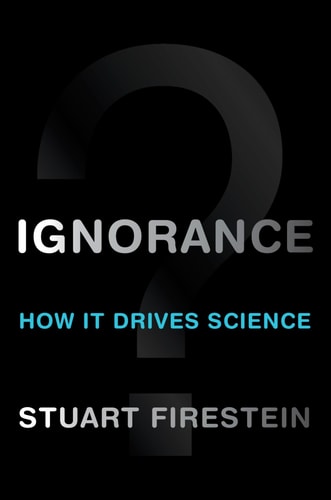
Ignorance: How It Drives Science
0
0
As an Amazon Associate and affiliate partner, Menrva Books earns from qualifying purchases. Learn more
Author Description
Knowledge is a big subject, says Stuart Firestein, but ignorance is a bigger one. And it is ignorance--not knowledge--that is the true engine of science.Most of us have a false impression of science as a surefire, deliberate, step-by-step method for finding things out and getting things done. In fact, says Firestein, more often than not, science is like looking for a black cat in a dark room, and there may not be a cat in the room. The process is more hit-or-miss than you might imagine, with much stumbling and groping after phantoms. But it is exactly this "not knowing," this puzzling over thorny questions or inexplicable data, that gets researchers into the lab early and keeps them there late, the thing that propels them, the very driving force of science. Firestein shows how scientists use ignorance to program their work, to identify what should be done, what the next steps are, and where they should concentrate their energies. And he includes a catalog of how scientists use ignorance, consciously or unconsciously--a remarkable range of approaches that includes looking for connections to other research, revisiting apparently settled questions, using small questions to get at big ones, and tackling a problem simply out of curiosity. The book concludes with four case histories--in cognitive psychology, theoretical physics, astronomy, and neuroscience--that provide a feel for the nuts and bolts of ignorance, the day-to-day battle that goes on in scientific laboratories and in scientific minds with questions that range from the quotidian to the profound.Turning the conventional idea about science on its head, Ignorance opens a new window on the true nature of research. It is a must-read for anyone curious about science.
Menrva's Summary
THE THESIS
This book investigates the core question of how scientific progress is driven not by the accumulation of known facts, but by the deliberate cultivation and exploration of ignorance. Stuart Firestein, a professor of neuroscience at Columbia University, challenges the popular perception of science as a linear, methodical process. He argues that the true engine of scientific discovery is the identification of what we do not know, utilizing this uncertainty to formulate new questions and guide experimental research.
THE SCOPE MAP
What You Will Find
- A conceptual framework for viewing ignorance as a productive, active tool in research rather than a lack of knowledge.
- Methodologies for identifying productive questions and navigating the uncertainty inherent in experimental design.
- Case studies from cognitive psychology, theoretical physics, astronomy, and neuroscience illustrating the practical application of these concepts.
- An analysis of how curiosity and the pursuit of the unknown sustain long-term scientific inquiry.
THE AUTHORITY PERSPECTIVE
Experts and readers alike praise this work for its accessible prose and its ability to demystify the often-opaque nature of scientific research. The text is frequently cited as a foundational resource for students and professionals looking to understand the creative, non-linear reality of laboratory work.
Page Count:
195
Publication Date:
2012-04-23
Publisher:
Oxford University Press
ISBN-10:
0199828075
ISBN-13:
9780199828074
Science
Non-Fiction
Earth Sciences
Science
Epistemology
Discoveries in science
Scientific Method
Community Tags
Similar Books