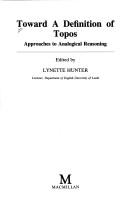
Toward a Definition of Topos
0
0
As an Amazon Associate and affiliate partner, Menrva Books earns from qualifying purchases. Learn more
Author Description
Allegories, rhetoric, imagery, commonplaces, cliches and archetypes are discussed in connection with the literary work of authors such as Montaigne, Shakespeare, Jules Verne, Emile Zola and James Joyce. The word 'topos' means place, either physical, natural, logical or rhetorical. This collections of essays covers a wide range of mostly English literature from Chaucer and Spenser, via Fielding, to Joyce, with one or two incursions into French writing, in the form of essays on Montaigne and Verne, seeking to apply a rhetorical understanding of 'topos' or commonplaces to the criticism of literature. -- Book jacket.
Menrva's Summary
THE THESIS
This collection of essays investigates the concept of 'topos,' meaning place, and its application to literary criticism. Lynette Hunter, an established scholar, applies a rhetorical understanding of 'topos' or commonplaces to the analysis of literature. The essays draw upon a wide range of mostly English literature, from Chaucer and Spenser through Fielding to Joyce, with specific attention to French writers Montaigne and Verne. The core argument explores how allegories, rhetoric, imagery, commonplaces, clichés, and archetypes function within these literary works.
THE SCOPE MAP
- Analysis of 'topos' as a rhetorical concept in literature.
- Examination of literary works from Chaucer, Spenser, Fielding, Shakespeare, Montaigne, Verne, Zola, and Joyce.
- Discussion of allegories, rhetoric, imagery, commonplaces, clichés, and archetypes.
- Application of rhetorical understanding to literary criticism.
THE AUTHORITY PERSPECTIVE
The collection applies a rhetorical understanding of 'topos' to literary criticism, examining a broad spectrum of English and French literature. The essays focus on concepts such as commonplaces, allegories, and archetypes as they appear in the works of canonical authors. The book's approach is analytical, seeking to define 'topos' through its practical application in literary analysis. This work is likely to appeal to scholars and students of literary theory and rhetoric.
Page Count:
231
Publication Date:
1991-01-01
ISBN-10:
0333523539
Non-Fiction
Philosophy
History
Literary Criticism
Rhetoric
Literary theory
Community Tags
Similar Books