Cornell '69
0
0
As an Amazon Associate and affiliate partner, Menrva Books earns from qualifying purchases. Learn more
Author Description
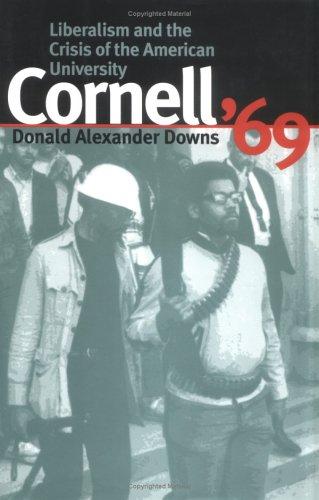
In April 1969, one of America's premier universities was celebrating parents' weekend - and the student union was an armed camp, occupied by over eighty defiant members of the campus's Afro-American Society. Marching out Sunday night, the protesters brandished rifles, their maxim: "If we die, you are going to die." Cornell '69 is an electrifying account of that weekend which probes the origins of the drama and describes how it was played out not only at Cornell but on campuses across the nation during the heyday of American liberalism. The weekend's traumatic turn of events is shown by Downs to be a harbinger of the debates raging today over the meaning of the university in American society. He explores the fundamental questions it posed, questions Americans on and off campus are still struggling to answer: What is the relationship between racial justice and intellectual freedom? What are the limits in teaching identity politics? And what is the proper meaning of the university in a democratic polity?
Menrva's Summary
THE THESIS
The occupation of Cornell University's student union by armed protesters in April 1969 serves as a focal point for a broader examination of campus unrest and the evolving role of universities in American society. Donald Alexander Downs's account delves into the origins of the Afro-American Society's defiant stance, exploring the weekend's events not just at Cornell but across the nation during a period of intense social and political change. The book probes fundamental questions about the intersection of racial justice and intellectual freedom, the boundaries of identity politics in academia, and the university's place within a democratic framework, issues that continue to resonate in contemporary debates.
THE SCOPE MAP
- Detailed account of the April 1969 student occupation of Cornell's student union.
- Exploration of the origins and context of the Afro-American Society's protest.
- Analysis of the events at Cornell in relation to broader campus movements nationwide.
- Examination of the historical period of American liberalism and its challenges.
- Discussion of the relationship between racial justice and intellectual freedom.
- Inquiry into the limits of teaching identity politics.
- Consideration of the proper meaning and function of the university in a democracy.
THE AUTHORITY PERSPECTIVE
The book is presented as a significant historical analysis that connects the events of 1969 at Cornell to ongoing debates about the purpose and function of universities in contemporary American society. Downs's work is framed as a probing examination of fundamental questions regarding racial justice, intellectual freedom, and identity politics within academic institutions. The narrative aims to illuminate the historical roots of current discussions, suggesting that the issues raised during that tumultuous weekend remain relevant and unresolved.
Page Count:
359
Publication Date:
1999-01-01
ISBN-10:
0801436532
History
Non-Fiction
Politics
Sociology
Community Tags
Similar Books