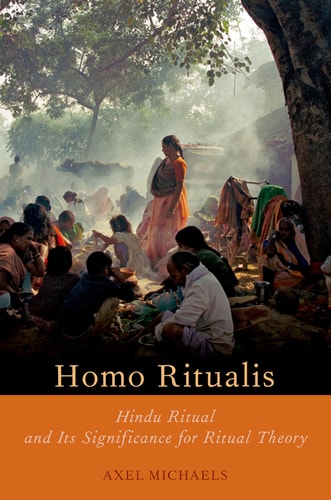
Homo Ritualis: Hindu Rituals and Its Significance for Ritual Theory
0
0
As an Amazon Associate and affiliate partner, Menrva Books earns from qualifying purchases. Learn more
Author Description
Is the richness and diversity of rituals and celebrations in South Asia unique? Are Indians or Hindus more involved in rituals than people of other faiths and other places? If so, what makes them special? Can we speak of a homo ritualis when it comes to India or Hinduism?Drawing on extensive textual studies and fieldwork in Nepal and India, Axel Michaels demonstrates how the characteristic structure of Hindu rituals employs the Brahmanic-Sanskritic sacrifice as a model, and how this structure is one of the distinguishing features of Hinduism more generally. Many religions tend over time to develop less ritualized or more open forms of belief, but Brahmanical Hinduism has internalized ritual behavior to the extent that it has become its most important and distinctive feature, permeating social and personal life alike. The religion can thus be seen as a particular case in the history of religions in which ritual form dominates belief and develops a sweeping autonomy of ritual behavior.Homo Ritualis analyzes ritual through these cultural-specific and religious contexts, taking into account how indigenous terms and theories affect and contribute to current ritual theory. It describes and investigates various forms of Hindu rituals and festivals, such as life-cycle rituals, the Vedic sacrifice, vows processions, and the worship of deities (puja). It also examines various conceptual components of (Hindu) rituals such as framing, formality, modality, and theories of meaning.
Menrva's Summary
THE THESIS
This book investigates whether the prevalence and structure of ritual in Hinduism justify the conceptualization of a homo ritualis, or a human defined primarily by ritual practice. Axel Michaels, a scholar of South Asian religions, utilizes a combination of textual analysis and ethnographic fieldwork conducted in Nepal and India. He argues that Brahmanical Hinduism is distinct in its internalization of ritual behavior, which has evolved to dominate belief systems and permeate all aspects of social and personal existence.
THE SCOPE MAP
What You Will Find
- Analysis of life-cycle rituals, Vedic sacrifices, vows, processions, and puja.
- Examination of conceptual components including framing, formality, and modality.
- Integration of indigenous terminology into contemporary ritual theory.
Scope Limits
- The study focuses primarily on Brahmanical Hinduism and does not provide a comprehensive survey of all global religious ritual practices.
- The analysis is limited to the specific cultural and religious contexts of South Asia.
THE AUTHORITY PERSPECTIVE
Scholars in the field of religious studies recognize this work as a significant contribution to the understanding of ritual autonomy within the Hindu tradition. Readers frequently note the academic density of the prose, which is intended for an audience familiar with anthropological and theological discourse.
Page Count:
400
Publication Date:
2015-01-01
Publisher:
Oxford University Press
ISBN-10:
019026263X
ISBN-13:
9780190262631
Religion
Hinduism
Ritual
Ritual Studies
Asian Studies
Cultural History
Anthropology
Community Tags
Similar Books