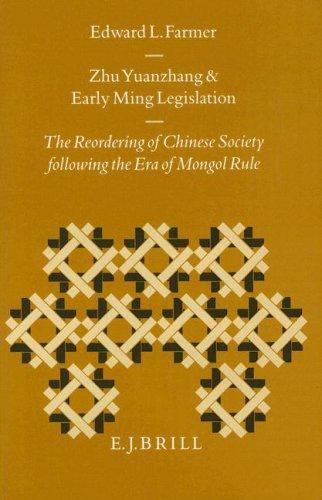
Zhu Yuanzhang and early Ming legislation
0
0
As an Amazon Associate and affiliate partner, Menrva Books earns from qualifying purchases. Learn more
Author Description
This volume deals with the social legislation of Zhu Yuanzhang, who founded the Ming dynasty (1368-1644), following the era of Mongol rule in China. It recounts the circumstances under which the laws were enacted and what the Emperor claimed he was trying to accomplish - a restoration of traditional Chinese social norms. The contents of several codes are discussed in terms of the groups to which they applied and the range of activities they purported to regulate. The early Ming codes formed one of the most comprehensive and cohesive bodies of law in all of Chinese history. Taken as a group, they constituted an autocrate's blueprint for the ideal society. The texts of three codifications - an imperial clan constitution, a general summary of the laws, and guidelines for village life - are translated as appendixes.
Menrva's Summary
THE THESIS
This volume examines the social legislation enacted by Zhu Yuanzhang, the founder of the Ming dynasty, in his effort to restore traditional Chinese social norms after Mongol rule. The book details the circumstances surrounding the creation of these laws, the Emperor's stated objectives, and the specific groups and activities the codes were intended to regulate. It highlights the early Ming codes as a remarkably comprehensive and cohesive legal system, representing an autocrat's vision for an ideal society.
THE SCOPE MAP
- Analysis of the social legislation of Zhu Yuanzhang, founder of the Ming dynasty.
- Discussion of the historical context and motivations behind the enactment of early Ming laws.
- Examination of the scope and application of various legal codes to different societal groups.
- Translation of three key codifications: an imperial clan constitution, a general summary of laws, and village life guidelines, presented as appendices.
THE AUTHORITY PERSPECTIVE
The book is recognized for its detailed examination of the early Ming legal system, particularly the social legislation implemented by Zhu Yuanzhang. The inclusion of translated codifications provides direct access to primary legal texts, offering scholars and students valuable resources for understanding the period. The work is considered a significant contribution to the study of Chinese legal history and the Ming dynasty's foundational policies.
Page Count:
259
Publication Date:
1995-01-01
ISBN-10:
9004103910
Politics
Non-Fiction
History
Legislation
Law
Chinese History
Community Tags
Similar Books