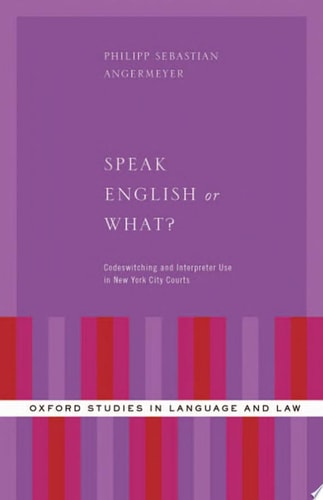
Speak English or What?: Codeswitching and Interpreter Use in New York City Courts
0
0
As an Amazon Associate and affiliate partner, Menrva Books earns from qualifying purchases. Learn more
Author Description
This book presents a study of interpreter-mediated interaction in New York City small claims courts, drawing on audio-recorded arbitration hearings and ethnographic fieldwork. Focusing on the language use of speakers of Haitian Creole, Polish, Russian, or Spanish, the study explores how these litigants make use of their limited proficiency in English, in addition to communicating with the help of professional court interpreters. Drawing on research on courtroom interaction, legal interpreting, and conversational codeswitching, the study explores how the ability of immigrant litigants to participate in these hearings is impacted by institutional language practices and underlying language ideologies, as well as by the approaches of individual arbitrators and interpreters who vary in their willingness to accommodate to litigants and share the burden of communication with them. Litigants are shown to codeswitch between the languages in interactionally meaningful ways that facilitate communication, but such bilingual practices are found to be in conflict with court policies that habitually discourage the use of English and require litigants to act as monolinguals, using only one language throughout the entire proceedings. Moreover, the standard distribution of interpreting modes in the courtroom is shown to disadvantage litigants who rely on the interpreter, as consecutive interpreting causes their narrative testimony to be less coherent and more prone to interruptions, while simultaneous interpreting often leads to incomplete translation of legal arguments or of their opponent's testimony. Consequently, the study raises questions about the relationship between linguistic diversity and inequality, arguing that the legal system inherently privileges speakers of English.
Menrva's Summary
THE THESIS
This book investigates how institutional language policies and the use of interpreters in New York City small claims courts create systemic inequality for immigrant litigants. Philipp Sebastian Angermeyer, a scholar in language and law, utilizes a combination of ethnographic fieldwork and audio-recorded arbitration hearings to analyze the communicative challenges faced by non-native English speakers. The work argues that court procedures often enforce a monolingual standard that conflicts with the natural codeswitching practices of litigants, thereby disadvantaging those who rely on interpretation services.
THE SCOPE MAP
What You Will Find
- Analysis of courtroom interactions involving Haitian Creole, Polish, Russian, and Spanish speakers.
- Evaluation of consecutive versus simultaneous interpreting modes and their impact on testimony coherence.
- Examination of how arbitrator and interpreter attitudes influence the burden of communication.
Scope Limits
- The study is limited to small claims courts in New York City and does not cover higher-level criminal or civil trial proceedings.
- It does not provide a comprehensive legal guide for court interpreters but focuses on the sociological and linguistic dynamics of the interaction.
THE AUTHORITY PERSPECTIVE
Experts in sociolinguistics and legal studies recognize this work as a significant contribution to the understanding of language ideologies within institutional settings. Readers frequently note the academic density of the prose, which provides a rigorous examination of how linguistic diversity intersects with legal access.
Page Count:
264
Publication Date:
2015-01-01
Publisher:
Oxford University Press
ISBN-10:
0190266511
ISBN-13:
9780190266516
United States
Bilingualism
Law
Linguistics
English
English & College Success
Cultural Anthropology
Professional Career & Trade
Courtroom Procedure
Language Policy
Communications
Community Tags
Other Editions(2)
Similar Books


Reader Comments
Share Your Thoughts
No comments yet. Be the first to share your thoughts!