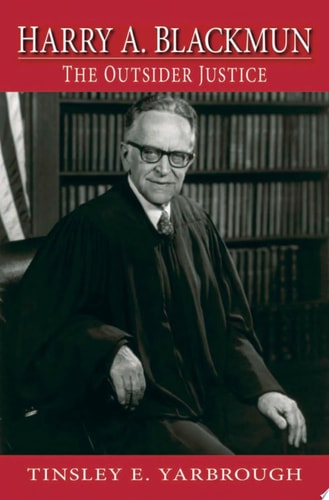
Harry A. Blackmun: The Outsider Justice
0
0
As an Amazon Associate and affiliate partner, Menrva Books earns from qualifying purchases. Learn more
Author Description
When appointed to the Supreme Court in 1970 by President Nixon, Harry A. Blackmun was seen as a quiet, safe choice to complement the increasingly conservative Court of his boyhood friend, Warren Burger. No one anticipated his seminal opinion championing abortion rights in Roe v. Wade, the most controversial ruling of his generation, which became the battle cry of both supporters and critics of judicial power and made Blackmun a liberal icon. Harry A. Blackmun: The Outsider Justice is Tinsley E. Yarbrough's penetrating account of one of the most outspoken and complicated figures on the Supreme Court. As a justice, Blackmun stood at the pinnacle of the American judiciary. Yet when he took his seat on the Court, Justice Blackmun felt "almost desperate," overwhelmed with feelings of self-doubt and inadequacy over the immense responsibilities before him. Blackmun had overcome humble roots to achieve a Harvard education, success as a Minneapolis lawyer and resident counsel to the prestigious Mayo Clinic, as well as a distinguished record on the Eighth Circuit federal appeals court. But growing up in a financially unstable home with a frequently unemployed father and an emotionally fragile mother left a permanent mark on the future justice. All his life, Harry Blackmun considered himself one of society's outsiders, someone who did not "belong." Remarkably, though, that very self-image instilled in the justice, throughout his career, a deep empathy for society's most vulnerable outsiders--women faced with unwanted pregnancies, homosexuals subjected to archaic laws, and ultimately, death-row inmates. To those who saw his career as the constitutional odyssey of a conservative jurist gradually transformed into a champion of the underdog, Blackmun had a ready answer: he had not changed; the Court and the issues before them changed. The justice's identification with the marginalized members of society arguably provides the overarching key to that consistency.
Menrva's Summary
THE THESIS
What internal psychological factors and external professional pressures shaped Harry A. Blackmun's evolution from a perceived conservative appointee to a champion of marginalized groups on the Supreme Court? Tinsley E. Yarbrough, a scholar of constitutional law and judicial biography, utilizes personal correspondence, court records, and historical context to argue that Blackmun's lifelong sense of being an outsider provided the foundation for his judicial empathy. The author examines how Blackmun's early life experiences and his tenure on the Eighth Circuit informed his approach to the most contentious legal issues of the late twentieth century.
THE SCOPE MAP
What You Will Find
- A detailed examination of Blackmun's upbringing and his professional trajectory through the Mayo Clinic and the Eighth Circuit.
- An analysis of the political climate surrounding his 1970 appointment by President Richard Nixon.
- A comprehensive review of his judicial philosophy, specifically regarding Roe v. Wade and death penalty jurisprudence.
Scope Limits
- The text does not provide an exhaustive legal analysis of every opinion issued during his tenure.
- The narrative focuses primarily on the psychological and personal motivations rather than a purely technical critique of his legal reasoning.
THE AUTHORITY PERSPECTIVE
Legal scholars and historians frequently cite this work as a balanced and insightful portrait of a complex jurist. Experts highlight the author's ability to synthesize personal history with judicial output, making it a standard reference for understanding the shifting ideological landscape of the modern Supreme Court.
Page Count:
403
Publication Date:
2008-01-01
Publisher:
Oxford University Press
ISBN-10:
0190286431
ISBN-13:
9780190286439
Biography
History
English
Supreme Court
Professional Career & Trade
United States
Law
Biography Autobiography
American Government
American History
English & College Success
Judges biography
Community Tags
Other Editions(2)

Similar Books
Reader Comments
Share Your Thoughts
No comments yet. Be the first to share your thoughts!