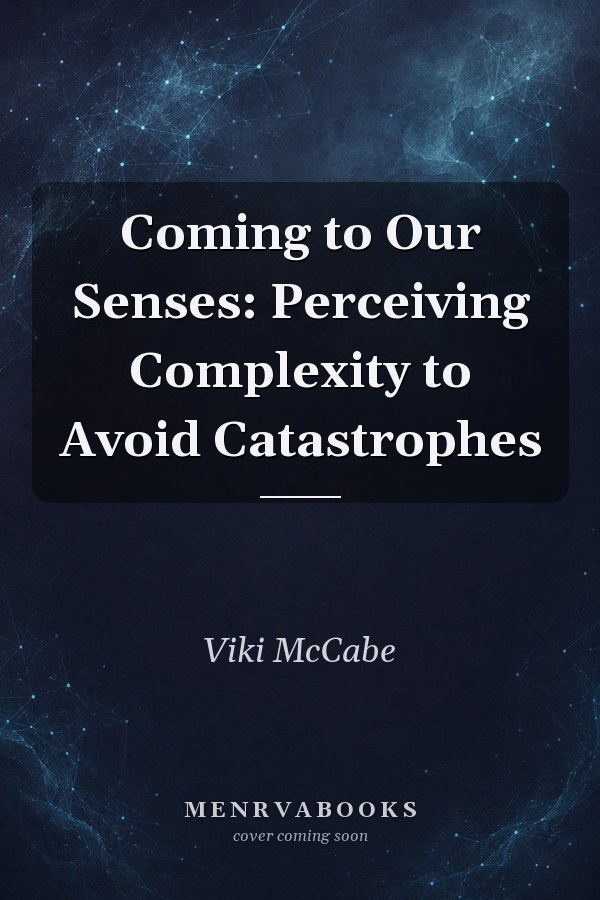
Coming to Our Senses: Perceiving Complexity to Avoid Catastrophes
0
0
As an Amazon Associate and affiliate partner, Menrva Books earns from qualifying purchases. Learn more
Author Description
In Coming to Our Senses, cognitive scientist Viki McCabe argues that prevailing theories of perception, cognition, and information cannot explain how we know the world around us. Using scientific studies and true stories, McCabe shows that the ecological disasters, political paralysis, and economic failures we now face originate in our tendency to privilege cognitive processes and products over the information we access with our perceptual systems. As a result, we typically default to making decisions using inaccurate information such as mechanistic theories that reduce the world to extractable, exploitable parts. But the world does not function as an assembly of parts; it functions as a coalition of complex systems--from cells to cities--that organize and sustain themselves and cannot be partitioned and retain their purpose. McCabe also argues that we cannot describe such systems using theories and words. Instead, each system reveals itself in fractal-like geometric configurations that emerge from and reflect the structural organization that brings it into existence and determines its functions--a veritable physics of information. Thus, we comprehend phenomena as disparate as neural networks, river deltas, and economies by perceiving the branching geometry that organizes them into distribution systems. McCabe's key point is that form not only follows function, it doubles as information. If we put our theories aside and focus on the information the world displays, our perceptions can block hostile mental takeovers, reconnect us to reality, and bring us back to our senses. -- Provided by publisher.
Menrva's Summary
THE THESIS
The central question investigated is how human reliance on abstract cognitive theories over direct perceptual information leads to systemic societal and ecological failures. Viki McCabe, a cognitive scientist, posits that modern decision-making processes are flawed because they reduce complex, self-organizing systems into exploitable parts. She argues that by shifting focus from mechanistic theories to the inherent fractal geometry and structural information present in the world, humans can better comprehend and interact with reality.
THE SCOPE MAP
What You Will Find
- Analysis of self-organizing systems ranging from biological neural networks to urban infrastructure.
- A framework for understanding the physics of information through geometric configurations.
- Case studies illustrating the consequences of ignoring systemic complexity in economics and politics.
Scope Limits
- The text does not provide a step-by-step manual for specific policy implementation.
- It does not offer a comprehensive history of cognitive psychology, focusing instead on the author's specific perceptual theory.
THE AUTHORITY PERSPECTIVE
Readers frequently note the dense, interdisciplinary nature of the prose, which bridges biology, physics, and cognitive science. Experts highlight this work as a challenging critique of traditional reductionist models in behavioral science.
Page Count:
288
Publication Date:
2015-12-01
Publisher:
Oxford University Press
ISBN-10:
0190263180
ISBN-13:
9780190263188
Psychology
Non-Fiction
Perception philosophy
Reality
Medical
Systems Theory
Perception
Knowledge Theory
Philosophy of
Allied Health
Community Tags
Similar Books