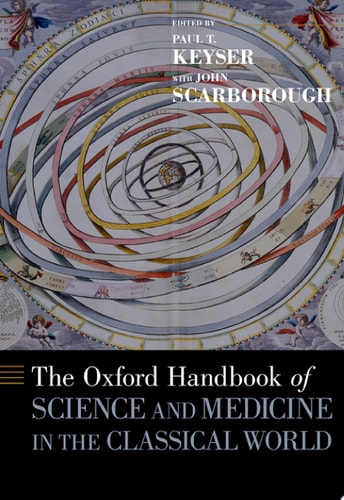
The Oxford Handbook of Science and Medicine in the Classical World (Oxford Handbooks)
0
0
As an Amazon Associate and affiliate partner, Menrva Books earns from qualifying purchases. Learn more
Author Description
With a focus on science in the ancient societies of Greece and Rome, including glimpses into Egypt, Mesopotamia, India and China, The Oxford Handbook of Science and Medicine in the Classical World offers an in depth synthesis of science and medicine circa 650 BCE to 650 CE.The Handbook comprises five sections, each with a specific focus on ancient science and medicine. The second section covers the early Greek era, up through Plato and the mid-fourth century bce. The third section covers the long Hellenistic era, from Aristotle through the end of the Roman Republic, acknowledging that the political shift does not mark a sharp intellectual break. The fourth section covers the Roman era from the late Republic through the transition to Late Antiquity. The final section covers the era of Late Antiquity, including the early Byzantine centuries. The Handbook provides through each of its approximately four dozen essays, a synthesis and synopsis of the concepts and models of the various ancient natural sciences, covering the early Greek era through the fall of the Roman Republic, including essays that explore topics such as music theory, ancient philosophers, astrology, and alchemy.The Oxford Handbook of Science and Medicine in the Classical World guides the reader to further exploration of the concepts and models of the ancient sciences, how they evolved and changed over time, and how they relate to one another and to their antecedents. There are a total of four dozen or so topical essays in the five sections, each of which takes as its focus the primary texts, explaining what is now known as well as indicating what future generations of scholars may come to know. Contributors suggest the ranges of scholarly disagreements and have been free to advocate their own positions. Readers are led into further literature (both primary and secondary) through the comprehensive and extensive bibliographies provided with each chapter.
Menrva's Summary
THE THESIS
This volume investigates the development, conceptual frameworks, and practical applications of science and medicine within the societies of Greece and Rome from 650 BCE to 650 CE. The editors, John Scarborough and Paul T. Keyser, have assembled a collection of essays from various scholars to synthesize the intellectual history of the ancient world. The text argues that ancient scientific thought was a complex, evolving system that bridged the gap between early philosophical inquiry and the structured medical and natural sciences of Late Antiquity.
THE SCOPE MAP
What You Will Find
- A chronological analysis spanning from the early Greek era through the Byzantine transition.
- Topical explorations of music theory, astrology, alchemy, and natural philosophy.
- Comprehensive bibliographies for each essay directing readers to primary and secondary source literature.
Scope Limits
- The text focuses primarily on the Mediterranean basin, with only limited comparative glimpses into Egypt, Mesopotamia, India, and China.
- It does not provide a singular, unified narrative but rather a collection of independent scholarly perspectives and debates.
THE AUTHORITY PERSPECTIVE
Scholars and students frequently identify this work as a foundational reference for understanding the intersection of ancient philosophy and empirical observation. Readers often note the academic density of the prose, which is intended for those with a serious interest in the history of science and classical antiquity.
Page Count:
1061
Publication Date:
2018-01-01
Publisher:
Oxford University Press
ISBN-10:
0190878835
ISBN-13:
9780190878832
Science
History
Earth Sciences
Trades & Technology
Ancient History
Medicine
English & College Success
Philosophy of
English
Medical
Allied Health
Technology & Engineering
Community Tags
Similar Books









Reader Comments
Share Your Thoughts
No comments yet. Be the first to share your thoughts!