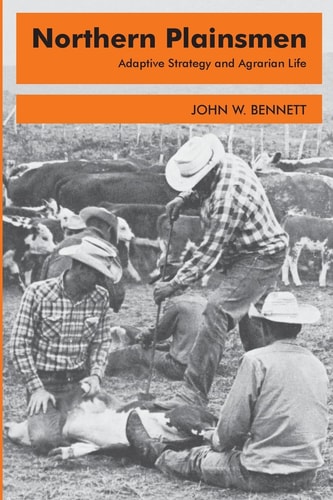
Northern Plainsmen: Adaptive Strategy and Agrarian Life
0
0
As an Amazon Associate and affiliate partner, Menrva Books earns from qualifying purchases. Learn more
Author Description
A study of a rural region and plural society, this book is a distinctive contribution to anthropology, in that it brings the conceptual framework of that discipline to bear on a contemporary agrarian society and its historical development, rather than on peasant or tribal peoples; cultural ecology, in that it shows the nature of the adaptations of four distinctive social groups to the environment of the Canadian Great Plains; the study of social and economic change, as it describes cultural patterns and mechanisms that are relevant to agrarian development the world over; and North American studies, in as much as it deals with community life in the classic sequence of settlement of the Western Plains.The book is, focused throughout on the adaptation of human societies to their environment. Four groups are described: the Cree Indians, the aboriginal inhabitants of the area who have lost all organic relationship to natural resources and who have devised ingenious methods for manipulating the social environment; ranchers, whose specialized production is based upon resources used in their natural state; homestead farmers, whose maladjusted small-farm economy, after initial setbacks, achieved a degree of stability through interventions by government in their adaptations to nature and the market economy; and the Hutterian Brethren, whose adaptation consisted primarily of the introduction to the region of a new kind of social organization.This book combines the anthropological concept of culture and the framework of ecology in the study of a modern social milieu; it focuses on a region rather than on a single culture, people, or community, so that the interplay of several social groups can be appreciated; and it elaborates contemporary anthropological and ecological theory in a manner that makes it applicable to the understanding of contemporary agrarian societies.John W. Bennett was emeritus professor of anthropology at Washington University, St. Louis. He served as presid
Menrva's Summary
THE THESIS
How do diverse social groups adapt their cultural and economic strategies to the specific environmental and historical constraints of the Canadian Great Plains? John W. Bennett, an emeritus professor of anthropology, utilizes a cultural ecology framework to analyze the development of a pluralistic rural society. By examining the interplay between four distinct groups—Cree Indians, ranchers, homestead farmers, and the Hutterian Brethren—Bennett argues that human adaptation is a complex process shaped by both natural resources and social organization. The study provides a model for understanding how agrarian societies evolve within modern market economies.
THE SCOPE MAP
What You Will Find
- Comparative analysis of four distinct social groups: Cree Indians, ranchers, homestead farmers, and Hutterian Brethren.
- Application of cultural ecology theory to modern, non-tribal agrarian settings.
- Examination of the historical sequence of settlement in the Western Canadian Plains.
- Evaluation of how government intervention and social organization influence economic stability.
THE AUTHORITY PERSPECTIVE
Scholars recognize this work as a foundational text for the application of ecological theory to modern rural communities. Readers frequently note the academic density of the prose, which serves as a rigorous examination of regional development and social adaptation.
Page Count:
382
Publication Date:
2007-02-15
Publisher:
Routledge
ISBN-10:
0202309649
ISBN-13:
9780202309644
History
Sociology
Anthropology
Canada
Saskatchewan
Community Tags
Other Editions(3)
Similar Books




Reader Comments
Share Your Thoughts
No comments yet. Be the first to share your thoughts!