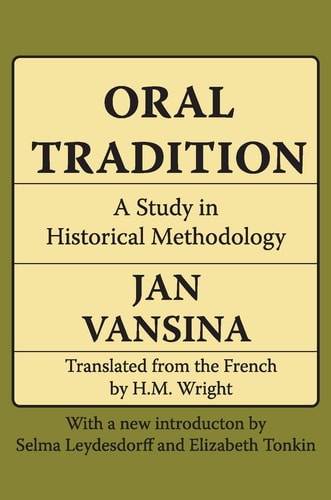
Oral Tradition: A Study in Historical Methodology
0
0
As an Amazon Associate and affiliate partner, Menrva Books earns from qualifying purchases. Learn more
Author Description
Oral traditions are historical sources of a special nature. Their special nature derives from the fact that they are "unwritten" sources couched in a form suitable for oral transmission, and that their preservation depends on the powers of memory of successive generations of human beings. In many parts of the world inhabited by peoples without writing, oral tradition forms the main available source for a reconstruction of the past. Do the special characteristics of oral traditions u "unwritten" information dependent on the memory of successive generations u invalidate them as sources of historical data? If not, are there means for testing their reliability? Professor Vansina shows in Oral Tradition that with knowledge of the language and of the society, the anthropologist and historian can extract or deduce the historical content of oral testimonies. Based on the author's many years of fieldwork in Africa, this definitive work explores the possibility of reconstructing the history of non-literate peoples from their oral traditions, surveys existing literature, offers a typology of oral traditions, and evaluates methods of collection and interpretation. On first publication, Daniel McCall in the American Anthropologist called Oral Tradition " a tour de force. Indeed this may well be the most significant work written on the relation of oral tradition to history in thirty yearsafor any field worker who intends to collect oral traditions, this work is indispensable."
Menrva's Summary
THE THESIS
Can oral traditions serve as reliable historical sources despite their reliance on human memory and lack of written documentation? Professor Jan Vansina, drawing upon extensive fieldwork in Africa, argues that oral traditions are valid historical sources when analyzed through a rigorous methodological framework. He posits that by integrating linguistic knowledge and sociological context, researchers can systematically extract historical data from non-literate societies, effectively bridging the gap between oral testimony and historical reconstruction.
THE SCOPE MAP
What You Will Find
- A comprehensive typology of oral traditions categorized by form and function.
- Methodological protocols for the collection and verification of oral testimonies.
- Analytical frameworks for evaluating the reliability and transmission of memory across generations.
- A critical survey of existing literature regarding the intersection of oral tradition and historical inquiry.
THE AUTHORITY PERSPECTIVE
Experts and historians recognize this work as a foundational text for field researchers working with non-literate societies. Readers frequently note the academic density of the prose, which provides a rigorous, systematic approach to a complex subject.
Page Count:
246
Publication Date:
2006-02-28
Publisher:
Routledge
ISBN-10:
0202308197
ISBN-13:
9780202308197
History
Oral Tradition
Anthropology
Research Methods
Sociology
History
Methodology
Community Tags
Similar Books