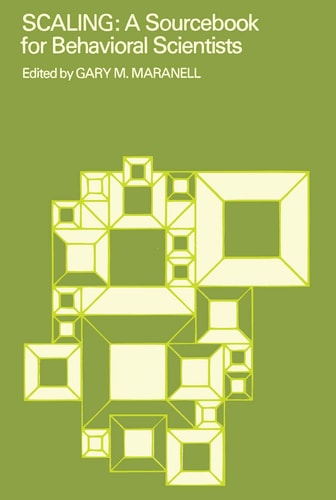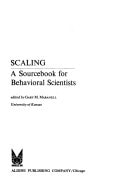
Scaling: A Sourcebook for Behavioral Scientists
0
0
As an Amazon Associate and affiliate partner, Menrva Books earns from qualifying purchases. Learn more
Author Description
Despite the obvious importance of measurement in any scientific endeavor, few students of the social sciences receive adequate training in the principles and problems of assigning numerical values to the subjects, objects, events, groups and operations they study, and still less in the process of translating theoretical ideas and concepts into variables. This kind of casualness with respect to measurement is often in marked contrast to their methodically designed research, which has grown out of subtle and sophisticated theoretical consideration.Scaling is intended to remedy this deficiency by providing a broad and detailed description of the major processes for developing measurement scales. The chapters, which include both classics in the field and the best of modern work, require no great mathematical sophistication, and go well beyond the conventional study of attitudes to the more general uses of scaling. They enable the student and researcher to examine the development of measures of scalability and the problems and weaknesses they present, to become familiar with the development of tests of significance for reproducibility and scalability and the need for them, and to examine the lively history of the subject and experience the excitement that can be secured from sharing with a creative author the first report of his insight.Part One presents a series of general articles that deal in philosophic terms with the problem of measurement, with what is meant by measurement and scaling as well as the notions underlying the process of measuring. Part Two deals with the scaling methods developed by L. L. Thurstone, including paired comparison scaling, equal-appearing interval scaling, and successive interval scaling. The third part focuses upon scalogram analysis, presenting the background, rationale and procedures for Guttman scaling. The fourth part is concerned with summated rating, or Likert scaling. Part Five is a consideration of unfolding theory and methods.
Menrva's Summary
THE THESIS
This volume investigates the fundamental principles and methodologies required to translate theoretical concepts into quantifiable variables within the behavioral sciences. Editor Gary M. Maranell compiles a comprehensive collection of foundational and contemporary texts to address the common deficiency in formal measurement training among social science students. The work argues that rigorous scaling is essential to bridge the gap between sophisticated theoretical frameworks and the practical application of research design.
THE SCOPE MAP
What You Will Find
- Philosophical foundations of measurement and the conceptual underpinnings of scaling processes.
- Detailed procedural guides for Thurstone scaling, including paired comparison and equal-appearing interval methods.
- Technical background and implementation strategies for Guttman scalogram analysis.
- Methodological frameworks for summated rating scales, specifically Likert scaling and unfolding theory.
THE AUTHORITY PERSPECTIVE
Experts recognize this sourcebook as a foundational reference for students and researchers seeking to understand the historical and practical evolution of measurement techniques. Readers frequently note that the text provides a clear, accessible entry point into complex psychometric methods without requiring advanced mathematical expertise.
Page Count:
436
Publication Date:
1981-01-01
Publisher:
Aldine Publishing Co.
ISBN-10:
020230227X
ISBN-13:
9780202302270
Psychology
Measurement Theory
Statistics
Sociology
Social Science
Research Methods
Community Tags
Similar Books