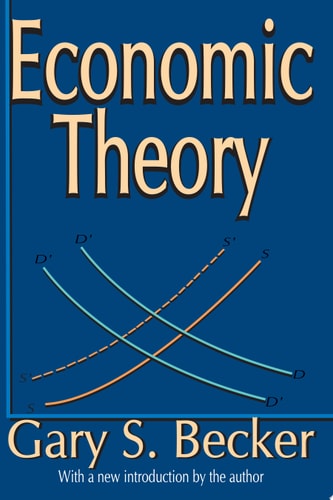
Economic Theory
0
0
As an Amazon Associate and affiliate partner, Menrva Books earns from qualifying purchases. Learn more
Author Description
Others might have called this book Micro Theory or Price Theory. Becker's choice of Economic Theory as the title for his book reflects his deep belief that there is only one kind of economic theory, not separate theories for micro problems, macro problems, non-market decisions, and so on. Indeed, as he notes, the most promising development in recent years in the literature on large scale economic problems such as unemployment has been the increasing reliance on utility maximization, a concept generally identified with microeconomics.Microeconomics is the subject matter of this volume, but it is emphatically not confined to microeconomics in the literal sense of micro units like firms or households. Becker's main interest is in market behavior of aggregations of firms and households. Although important inferences are drawn about individual firms and households, the author tries to understand aggregate responses to changes in basic economic parameters like tax rates, tariff schedules, technology, or antitrust provisions. His discussion is related to the market sector in industrialized economies, but the principles developed are applied to other sectors and different kinds of choices.Becker argues that economic analysis is essential to understand much of the behavior traditionally studied by sociologists, anthropologists, and other social scientists. The broad definition of economics in terms of scarce means and competing ends is taken seriously and should be a source of pride to economists since it provides insights into a wide variety of problems. Practically all statements proved mathematically are also provided geometrically or verbally in the body of the text.
Menrva's Summary
THE THESIS
This book investigates the core proposition that a unified economic theory, rooted in utility maximization, can effectively explain both microeconomic phenomena and large-scale aggregate social behaviors. Gary S. Becker, a Nobel laureate in Economics, utilizes his extensive background in human capital and social economics to argue against the compartmentalization of economic thought. By applying the principles of scarce means and competing ends to diverse sectors, he demonstrates that the analytical tools of microeconomics are sufficient to address complex societal issues traditionally reserved for sociologists and anthropologists. The text serves as a rigorous framework for viewing all human decision-making through a singular, cohesive economic lens.
THE SCOPE MAP
What You Will Find
- Analysis of market behavior regarding aggregations of firms and households.
- Application of utility maximization to large-scale economic problems like unemployment.
- Mathematical proofs supplemented by geometric and verbal explanations for accessibility.
- Theoretical extensions of economic principles into non-market decision-making and social sciences.
THE AUTHORITY PERSPECTIVE
Experts recognize this work as a foundational text that bridges the gap between traditional microeconomic theory and broader social analysis. Readers frequently note the technical density of the prose, which balances rigorous mathematical modeling with clear verbal explanations of complex economic parameters.
Page Count:
242
Publication Date:
2007-01-15
Publisher:
Routledge
ISBN-10:
0202309800
ISBN-13:
9780202309804
Economics
Microeconomics
Social Science
Economic Theory
Community Tags
Other Editions(3)


Similar Books









Reader Comments
Share Your Thoughts
No comments yet. Be the first to share your thoughts!