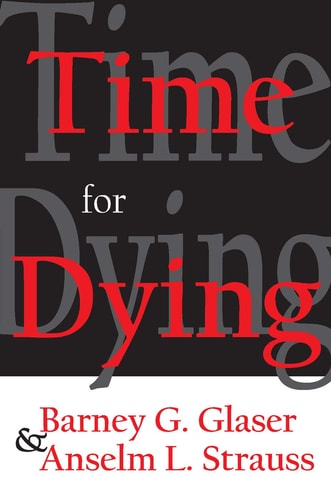
Time for Dying
0
0
As an Amazon Associate and affiliate partner, Menrva Books earns from qualifying purchases. Learn more
Author Description
This book has been written for those who must work with and give care to the dying. Our discussion is not simple narrative or description; it is a "rendition of reality," informed by a rather densely woven and fairly abstract theoretical scheme. This scheme evolved gradually during the course of our research. The second audience for this volume is social scientists who are less interested in dying than they are in useful substantive theory. Our central concern is with the temporal aspects of work. The theory presented here may be useful to social scientists interested in areas far removed from health, medicine, or hospitals. The training of physicians and nurses equips them for the technical aspects of dealing with illness.Medical students learn not to kill patients through error, and to save lives through diagnosis and treatment. But their teachers put little or no emphasis on how to talk with dying patients; how-or whether-to disclose an impending death; or even how to approach the subject with the wives, husbands, children, and parents of the dying. Students of nursing are taught how to give nursing care to terminal patients, as well as how to give "post-mortem care." But the psychological aspects of dealing with the dying and their families are virtually absent from training. Although physicians and nurses are highly skilled at handling the bodies of terminal patients, their behavior to them otherwise is actually outside the province of professional standards. Much, if not most, nontechnical conduct toward, and in the presence of, dying patients and their families is profoundly influenced by "common sense" assumptions, essentially untouched by professional or even rational considerations or by current advancement in social-psychological knowledge. The process of dying in hospitals is much affected by professional training and codes, and by the particular conditions of work generated by hospitals as places of work. A third important consideration in interpreting
Menrva's Summary
THE THESIS
This book investigates the intersection of professional medical training and the social-psychological realities of caring for dying patients within hospital environments. The author, Graham McAleer, utilizes a theoretical framework developed through extensive research to argue that medical education focuses heavily on technical proficiency while neglecting the interpersonal and temporal dimensions of end-of-life care. By examining the hospital as a workplace, the text provides a structured analysis of how professional codes and common-sense assumptions dictate the behavior of staff toward terminal patients and their families.
THE SCOPE MAP
What You Will Find
- Analysis of the temporal aspects of work in clinical settings.
- Theoretical frameworks for understanding social interaction in hospitals.
- Examination of the gap between technical medical training and psychological care.
- Case studies and observations regarding the disclosure of impending death to patients and families.
THE AUTHORITY PERSPECTIVE
Experts identify this work as a significant contribution to medical sociology, particularly for its focus on the institutional constraints of hospital care. Readers frequently note the academic density of the prose, which is designed to provide a rigorous theoretical foundation for both healthcare practitioners and social scientists.
Page Count:
286
Publication Date:
2007-01-15
Publisher:
Routledge
ISBN-10:
0202308588
ISBN-13:
9780202308586
Psychology
Professional Development
Sociology
Psychological aspects
Health Care
Medicine
Community Tags
Other Editions(3)

Similar Books








Reader Comments
Share Your Thoughts
No comments yet. Be the first to share your thoughts!