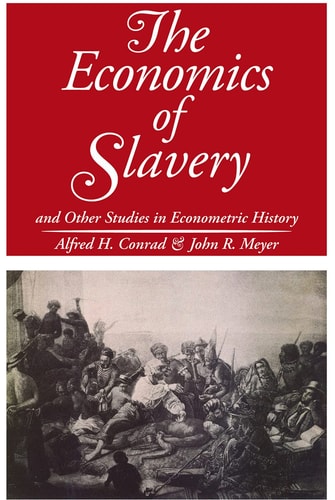
The Economics of Slavery: And Other Studies in Econometric History
0
0
As an Amazon Associate and affiliate partner, Menrva Books earns from qualifying purchases. Learn more
Author Description
How are economists and historians to explain what happened in history? What statistical inferences can be drawn from historical data? The authors believe that explanation in history can be identified with the problems of prediction in a probabilistic universe. Using this approach, the historian can act upon his a priori information and his judgment of what is unique and particular in each past event, even with data hitherto considered to be intractable for statistical treatment. In essence, the book is an argument for and a demonstration of the point of view that the restricted approach of "measurement without theory" is not necessary in history, or at least not necessary in economic history.After two chapters of theoretical introduction, the authors explore the meanings and implications of evidence, explanation and proof in history by applying econometric methods to the analysis of three major problems in 19th century economic history--the profitability of slavery in the antebellum South, income growth and development in the United States during the 1800's, and The Great Depression in the British economy; also included is a postscript on growth reassessing some current arguments in the light of the findings of these papers.The book presents an original and provocative approach to historical problems that have long plagued economists and historians and provides the reader with a new approach to these and similar questions.
Menrva's Summary
THE THESIS
This work investigates how econometric methods can be systematically applied to historical data to resolve long-standing debates regarding economic causality and prediction. John R. Meyer and his co-authors argue that historical explanation is fundamentally a problem of probabilistic prediction, rejecting the notion that historical data is inherently intractable for statistical analysis. By integrating a priori information with rigorous quantitative modeling, the authors demonstrate that economic history can move beyond descriptive narratives toward a more robust, theory-driven framework.
THE SCOPE MAP
What You Will Find
- Econometric modeling applied to 19th-century economic history.
- Analysis of the profitability of slavery in the antebellum American South.
- Statistical examination of income growth and development in the United States during the 1800s.
- Quantitative assessment of the Great Depression within the British economy.
- A methodological critique of the 'measurement without theory' approach in historical research.
THE AUTHORITY PERSPECTIVE
Experts recognize this volume as a foundational text in the development of cliometrics, noting its significant influence on the integration of statistical methods into historical inquiry. Readers frequently highlight the technical density of the prose, which assumes a strong background in economic theory and statistical analysis.
Page Count:
254
Publication Date:
2007-03-15
Publisher:
Routledge
ISBN-10:
0202309347
ISBN-13:
9780202309347
Economics
History
Econometrics
Slavery
United States
Great Britain
Economic History
Community Tags
Similar Books