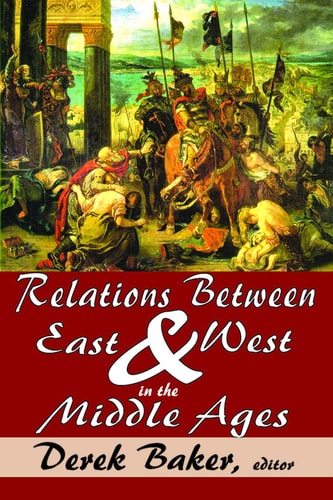
Relations Between East and West in the Middle Ages
0
0
As an Amazon Associate and affiliate partner, Menrva Books earns from qualifying purchases. Learn more
Author Description
In the Roman Empire, relations between East and West meant connections between the eastern and western parts of a unified structure of empire. Romans sometimes complained about the corrupting influence on their city of Greeks and Orientals, but they employed Greek tutors to educate their sons. People did not think of the eastern and western parts of the empire as being separate entities whose relations with each other must be the object of careful study. Even at the moment of the empire's birth, there was a clear idea of where the Latin West ended and the Greek East began. This began to change with Constantine, when the Roman Empire was split in two, with Rome itself in decay.This volume, first published in 1973, derives from a colloquium on medieval history held at Edinburgh University. Its theme was the fl uctuating balance-of-power of Latin West and Greek East, Rome and Constantinople. The book starts with Justinian's attempt to reunite the two halves of the old Roman Empire and then goes on to consider the polarization of Christianity into its Catholic and Orthodox sectors, and the misunderstandings fostered by the Crusades; and ends with the growing power and conquests of Islam in the fourteenth century.The contributions included in Relations between East and West in the Middle Ages are: Old and New Rome in the Age of Justinian, by W. H. C. Frend; The Tenth Century in Byzantine-Western Relationships, by Karl Leyser; William of Tyre, by R. H. C. Davis; Cultural Relations between East and West in the Twelfth Century, by Anthony Bryer; Innocent III and the Greeks, Aggressor or Apostle? by Joseph Gill; Government in Latin Syria and the Commercial Privileges of Foreign Merchants, by Jonathan Riley-Smith; and Dante and Islam, by R. W. Southern.
Menrva's Summary
THE THESIS
This volume investigates the shifting geopolitical and religious dynamics between the Latin West and the Greek East from the age of Justinian through the fourteenth century. Derek Baker compiles a series of scholarly contributions that examine how the initial unity of the Roman Empire fractured into distinct cultural and ecclesiastical spheres. By analyzing the political, commercial, and religious interactions between Rome and Constantinople, the text argues that these relations were defined by a fluctuating balance of power and persistent misunderstanding.
THE SCOPE MAP
What You Will Find
- Historical analysis of the transition from a unified Roman Empire to the polarized Catholic and Orthodox sectors.
- Examination of the impact of the Crusades on East-West diplomatic and cultural relations.
- Case studies on specific figures and events, including the reign of Justinian, the influence of Innocent III, and the literary legacy of Dante regarding Islam.
- Scholarly perspectives on the commercial privileges of foreign merchants in Latin Syria and the cultural exchanges of the twelfth century.
THE AUTHORITY PERSPECTIVE
Experts recognize this collection as a foundational academic resource for understanding the complexities of medieval Mediterranean relations. Readers frequently note the scholarly density of the prose, which provides a rigorous examination of the political and religious tensions that shaped the medieval world.
Page Count:
168
Publication Date:
2010-01-15
Publisher:
Routledge
ISBN-10:
0202363325
ISBN-13:
9780202363325
Politics
History
Religious History
Byzantine History
European History