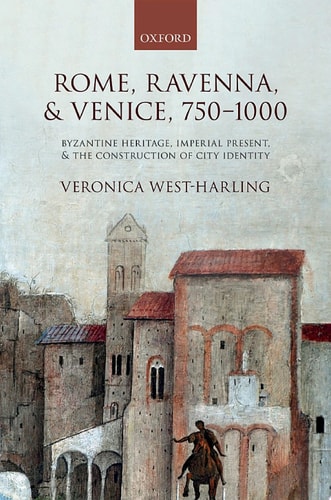
Rome, Ravenna, and Venice, 750-1000: Byzantine Heritage, Imperial Present, and the Construction of City Identity
0
0
As an Amazon Associate and affiliate partner, Menrva Books earns from qualifying purchases. Learn more
Author Description
The richest and most politically complex regions in Italy in the earliest middle ages were the Byzantine sections of the peninsula, thanks to their links with the most coherent early medieval state, the Byzantine empire. This comparative study of the histories of Rome, Ravenna, and Venice examines their common Byzantine past, since all three escaped incorporation into the Lombard kingdom in the late 7th and early 8th centuries. By 750, however, Rome and Ravenna's political links with the Byzantine Empire had been irrevocably severed. Thus, did these cities remain socially and culturally heirs of Byzantium? How did their political structures, social organisation, material culture, and identities change? Did they become part of the Western political and ideological framework of Italy? This study identifies and analyses the ways in which each of these cities preserved the structures of the Late Antique social and cultural world; or in which they adapted each and every element available to them to their own needs, at various times and in various ways, to create a new identity based partly on their Roman heritage and partly on their growing integration with the rest of medieval Italy. It tells a story which encompasses the main contemporary narratives, documentary evidence, recent archaeological discoveries, and discussions on art history; it follows the markers of status and identity through titles, names, ethnic groups, liturgy and ritual, foundation myths, representations, symbols, and topographies of power to shed light on a relatively little known area of early medieval Italian history.
Menrva's Summary
THE THESIS
This study investigates how Rome, Ravenna, and Venice navigated the transition from Byzantine influence to independent medieval identities between 750 and 1000. Veronica West-Harling, a specialist in medieval Italian history, utilizes a comparative framework to analyze how these three cities adapted their Late Antique heritage. By examining political structures, social organization, and material culture, the author argues that these cities actively constructed new identities through a synthesis of Roman tradition and emerging medieval Italian realities.
THE SCOPE MAP
What You Will Find
- Comparative analysis of urban development in Rome, Ravenna, and Venice.
- Examination of markers of status including titles, liturgy, ritual, and foundation myths.
- Integration of contemporary narrative sources, documentary evidence, and archaeological findings.
Scope Limits
- The study focuses specifically on the period between 750 and 1000.
- It does not provide a comprehensive history of the entire Italian peninsula, focusing instead on these three specific urban centers.
THE AUTHORITY PERSPECTIVE
Scholars recognize this work as a significant contribution to the understanding of early medieval urban identity and the lingering influence of Byzantium in Italy. Readers frequently note the academic density of the prose and the author's meticulous synthesis of diverse archaeological and textual sources.
Page Count:
705
Publication Date:
2020-01-01
Publisher:
OUP Oxford
ISBN-10:
0191069132
ISBN-13:
9780191069130
History
Europe
Italian History
Urban Studies
Cultural History
European History
Byzantine History
Community Tags
Similar Books