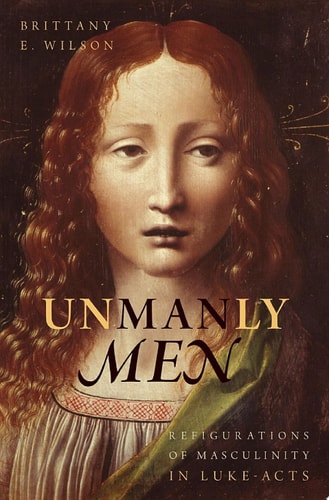
Unmanly Men: Refigurations of Masculinity in Luke-Acts
0
0
As an Amazon Associate and affiliate partner, Menrva Books earns from qualifying purchases. Learn more
Author Description
New Testament scholars typically assume that the men who pervade the pages of Luke's two volumes are models of an implied "manliness." Scholars rarely question how Lukan men measure up to ancient masculine mores, even though masculinity is increasingly becoming a topic of inquiry in the field of New Testament and its related disciplines. Drawing especially from gender-critical work in classics, Brittany Wilson addresses this lacuna by examining key male characters in Luke-Acts in relation to constructions of masculinity in the Greco-Roman world. Of all Luke's male characters, Wilson maintains that four in particular problematize elite masculine norms: namely, Zechariah (the father of John the Baptist), the Ethiopian eunuch, Paul, and, above all, Jesus. She further explains that these men do not protect their bodily boundaries nor do they embody corporeal control, two interrelated male gender norms. Indeed, Zechariah loses his ability to speak, the Ethiopian eunuch is castrated, Paul loses his ability to see, and Jesus is put to death on the cross. With these bodily "violations," Wilson argues, Luke points to the all-powerful nature of God and in the process reconfigures--or refigures--men's own claims to power. Luke, however, not only refigures the so-called prerogative of male power, but he refigures the parameters of power itself. According to Luke, God provides an alternative construal of power in the figure of Jesus and thus redefines what it means to be masculine. Thus, for Luke, "real" men look manifestly unmanly. Wilson's findings in Unmanly Men will shatter long-held assumptions in scholarly circles and beyond about gendered interpretations of the New Testament, and how they can be used to understand the roles of the Bible's key characters.
Menrva's Summary
THE THESIS
This work investigates how the male characters in Luke-Acts challenge and reconfigure traditional Greco-Roman masculine norms to present an alternative understanding of divine power. Brittany E. Wilson, a scholar of the New Testament, utilizes gender-critical frameworks from the field of classics to analyze the physical and social status of key male figures. She argues that by depicting characters who lack traditional bodily control and autonomy, the author of Luke-Acts subverts elite masculine expectations to emphasize the sovereignty of God.
THE SCOPE MAP
What You Will Find
- Analysis of four primary male figures: Zechariah, the Ethiopian eunuch, Paul, and Jesus.
- Examination of Greco-Roman gender norms regarding bodily boundaries and corporeal control.
- Theological exploration of how power is redefined through the lens of vulnerability.
Scope Limits
- The study focuses specifically on the Lukan corpus rather than the entire New Testament canon.
- It does not provide a comprehensive history of gender in the ancient Mediterranean beyond the specific context of Lukan theology.
THE AUTHORITY PERSPECTIVE
Scholars recognize this text as a significant contribution to the intersection of gender studies and biblical criticism. Readers frequently note the academic density of the prose and the precision with which the author applies classical gender theory to theological narratives.
Page Count:
359
Publication Date:
2015-01-01
Publisher:
Oxford University Press
ISBN-10:
019026649X
ISBN-13:
9780190266493
Religion
Gender Studies
Bibles
Special Topics
Roman History
Theology
New Testament
Community Tags
Similar Books