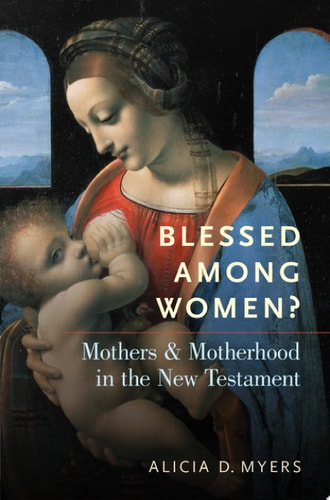
Blessed Among Women?: Mothers and Motherhood in the New Testament
0
0
As an Amazon Associate and affiliate partner, Menrva Books earns from qualifying purchases. Learn more
Author Description
Mothers appear throughout the New Testament. Called "blessed among women" by Elizabeth in the Gospel of Luke, Mary, the mother of Jesus, is the most obvious example. But she is far from the only mother in this canon. She is joined by Elizabeth, a chorus of unnamed mothers seeking healing or promotions for their children, as well as male mothers, including Paul (Gal 4:19-20) and Jesus. Although interpreters of the New Testament have explored these maternal characters and metaphors, many have only recently begun to take seriously their theological aspects. This book builds on previous studies by arguing maternal language is not only theological, but also indebted to ancient gender constructions and their reshaping by early Christians. Especially significant are the physiological, anatomical, and social constructions of female bodies that permeate the ancient world where ancient Christianity was birthed. This book examines ancient generative theories, physiological understandings of breast milk and breastfeeding, and presentations of prominent mothers in literature and art to analyze the use of these themes in the New Testament and several, additional early Christian writings. In a context that aligned perfection with "masculinity," motherhood was the ideal goal for women-a justification for deficient, female existence. Proclaiming a new age ushered in by God's Christ, however, ancient Christians debated the place of women, mothers, and motherhood as a part of their reframing of gender expectations. Rather than a homogenous approval of literal motherhood, ancient Christian writings depict a spectrum of ideals for women disciples even as they retain the assumption of masculine superiority. Identifying themselves as members of God's household, ancient Christians utilized motherhood as a theological category and a contested ideal for women disciples.
Menrva's Summary
THE THESIS
This book investigates how early Christian writers utilized maternal language and imagery to reshape theological understandings of gender and discipleship. Alicia D. Myers, an associate professor of New Testament and Greek, draws upon ancient medical theories, social history, and literary analysis to argue that maternal metaphors were deeply embedded in the physiological and gendered assumptions of the ancient world. By examining these texts, the author demonstrates that motherhood served as both a contested ideal and a complex theological category for early Christians navigating their identity within the Roman Empire.
THE SCOPE MAP
What You Will Find
- Analysis of ancient generative theories and physiological understandings of breast milk and breastfeeding.
- Examination of prominent maternal figures in New Testament texts, including Mary and Elizabeth.
- Investigation of metaphorical "male mothers" such as Paul and Jesus.
- Comparative study of early Christian literature and contemporary art.
Scope Limits
- The book does not provide a comprehensive history of women in the early church outside of the specific lens of maternal theology.
- It does not focus on modern applications of these theological concepts, remaining strictly within the ancient context.
THE AUTHORITY PERSPECTIVE
Scholars and students of biblical studies frequently highlight this work as a rigorous contribution to the intersection of gender studies and early Christian theology. The text is noted for its academic density and its successful integration of ancient medical and social history into the interpretation of canonical and non-canonical writings.
Page Count:
239
Publication Date:
2017-01-01
Publisher:
Oxford University Press
ISBN-10:
0190677104
ISBN-13:
9780190677107
History
Religion
Christianity
Motherhood
Special Topics
The Bible
Gender Studies
Bibles
Theology
Community Tags
Similar Books