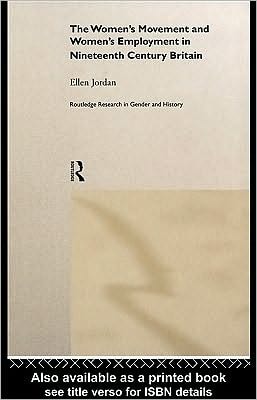
Women's Movement and Women's Employment in Nineteenth Century Britain
0
0
As an Amazon Associate and affiliate partner, Menrva Books earns from qualifying purchases. Learn more
Author Description
In the first half of the nineteenth century the main employments open to young women in Britain were in teaching, dressmaking, textile manufacture and domestic service. After 1850, however, young women began to enter previously all-male areas like medicine, pharmacy, librarianship, the civil service, clerical work and hairdressing, or areas previously restricted to older women like nursing, retail work and primary school teaching. This book examines the reasons for this change. The author argues that the way femininity was defined in the first half of the century blinded employers in the new industries to the suitability of young female labour. This definition of femininity was, however, contested by certain women who argued that it not only denied women the full use of their talents but placed many of them in situations of economic insecurity. This was a particular concern of the Womens Movement in its early decades and their first response was a redefinition of feminity and the promotion of academic education for girls. The author demonstrates that as a result of these efforts, employers in the areas targeted began to see the advantages of employing young women, and young women were persuaded that working outside the home would not endanger their femininity. Ellen Jordans treatment of the expansion of middle class womens work is perhaps the most comprehensive available and is a valuable complement to existing works on the social and economic history of women. She also offers new perspectives on the Womens Movement, womens education, labour history and the history of feminism.
Menrva's Summary
THE THESIS
This book investigates the socio-economic factors that facilitated the expansion of employment opportunities for women in nineteenth-century Britain. Ellen Jordan, a scholar of social and labor history, utilizes historical records and feminist theory to argue that the transition of women into previously male-dominated professions was driven by a deliberate redefinition of femininity. By examining the intersection of the early women's movement and industrial labor needs, the author demonstrates how the promotion of academic education for girls successfully challenged existing economic barriers.
THE SCOPE MAP
What You Will Find
- Analysis of labor market shifts in nineteenth-century Britain, including medicine, pharmacy, and clerical work.
- Examination of the early women's movement's role in redefining gender norms.
- Evaluation of the impact of academic education on female employment prospects.
- Historical assessment of the transition from domestic service and textile work to professional sectors.
THE AUTHORITY PERSPECTIVE
Historians and scholars of gender studies identify this work as a comprehensive resource for understanding the evolution of middle-class female labor. The text is frequently cited for its detailed synthesis of labor history and the ideological shifts within the nineteenth-century feminist movement.
Page Count:
288
Publication Date:
2002-01-01
Publisher:
Taylor & Francis Group
ISBN-10:
020302110X
ISBN-13:
9780203021101
History
Labor history
Women & Employment
Women - Europe
Social Aspects
Feminism
Women
Social History
Great Britain
Community Tags
Other Editions(3)


Similar Books







Reader Comments
Share Your Thoughts
No comments yet. Be the first to share your thoughts!