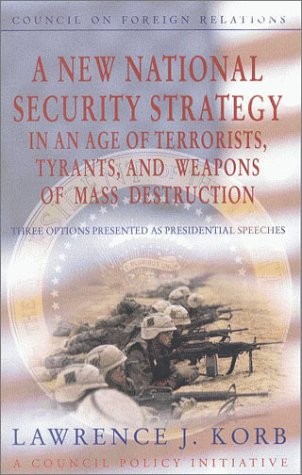
A New National Security Strategy in an Age of Terrorists, Tyrants, and Weapons of Mass Destruction
0
0
As an Amazon Associate and affiliate partner, Menrva Books earns from qualifying purchases. Learn more
Author Description
Almost exactly a year after the September 11, 2001, terrorist attacks, President George W. Bush released to Congress and the American public his National Security Strategy, the most detailed and comprehensive statement of how his administration intends to protect the security of the United States in the post-September 11 world. While few have disagreed with the goals of the strategy, a great deal of controversy has arisen about how these goals should be implemented. This innovative paper, written by Senior Fellow Lawrence Korb, an expert with decades of experience on national security issues, lays out the best case for three different ways in which the administration could implement the president's strategy. The first option recognizes that the traditional strategies of deterrence and containment will not work against tyrants and terrorists. Hence, it proposes that the United States adopt a bold new strategy of dominance and preventive action that elevates pre-emption to a cardinal norm, maintains military dominance, and actively seeks to extend free-market democracy throughout the globe. The second option asserts that active deterrence and containment will continue to work against even the most ruthless tyrants, that pre-emption should be reserved for exceptional circumstances, and that the United States needs only sufficient military power to protect its vital interests and should not overextend itself by trying to remake the world in its own image. The final option emphasizes that even with its great power, the United States cannot win the war against terrorists and tyrants unilaterally. Therefore, the best way for the United States to protect its interests is to work multilaterally with its allies and partners to create a more cooperative, rule-based international system backed by American power. With the aim of generating thought and debate about national security, Lawrence Korb has written an insightful book that presents each alternative as presidential spe
Menrva's Summary
THE THESIS
The book investigates the most effective national security strategy for the United States in the face of contemporary threats. Lawrence J. Korb, an expert with decades of experience, presents three distinct approaches to implementing President George W. Bush's post-September 11th National Security Strategy. The first option advocates for a strategy of dominance and preventive action, emphasizing pre-emption and military supremacy. The second option argues for the continued efficacy of active deterrence and containment, reserving pre-emption for exceptional cases and focusing on protecting vital interests without overextension. The third option proposes a multilateral approach, stressing cooperation with allies to build a rule-based international system backed by American power.
THE SCOPE MAP
- Analysis of the traditional strategies of deterrence and containment in the context of modern threats.
- Proposal for a strategy of dominance and preventive action, elevating pre-emption.
- Argument for the continued effectiveness of active deterrence and containment against ruthless tyrants.
- Discussion on the necessity of sufficient military power versus overextension.
- Emphasis on a multilateral approach, working with allies and partners.
- Exploration of creating a cooperative, rule-based international system.
- Presentation of each alternative as a viable presidential option for national security.
THE AUTHORITY PERSPECTIVE
This book is presented as an insightful analysis aimed at generating thought and debate on national security strategy. The author, Lawrence Korb, is recognized as an expert with extensive experience in the field. The work meticulously lays out three different, well-reasoned options for implementing the president's strategy, allowing readers to consider the merits and implications of each. The reception is framed around its utility in fostering discussion and understanding of complex geopolitical challenges.
Page Count:
150
Publication Date:
2003-01-01
ISBN-10:
0876093292
ISBN-13:
9780876093290
Politics
Non-Fiction
International relations
Foreign Policy
National security
Terrorism
Community Tags
Similar Books