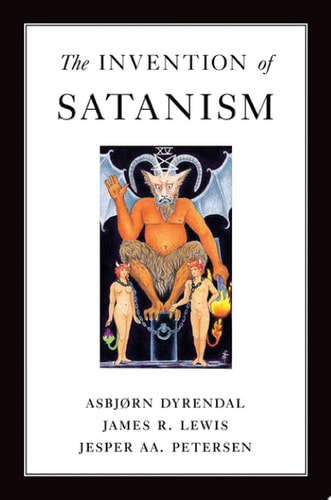
The Invention of Satanism
0
0
As an Amazon Associate and affiliate partner, Menrva Books earns from qualifying purchases. Learn more
Author Description
Satanism is a complex phenomenon that has often been the source of controversy across social and rhetorical contexts. Some consider it the root of all evil. Others see it as a childish form of rebellion or as a misapplication of serious esoteric beliefs and practices. Still others consider it a specific religion or philosophy that serves as a form of personal and collective identity. In The Invention of Satanism, three experts explore Satanism as a contemporary movement that is in continuous dialogue with popular culture, and which provides a breeding ground for other new religious movements. By shifting the focus from mythology to meaning-making, this book examines the invention of Satanism among self-declared religious Satanists. Like all ideologists and believers, Satanists incorporate, borrow, and modify elements from other traditions; the authors investigate how traditional folklore and prior strands of occultism were synthesized by Anton LaVey in his founding of the Church of Satan and creation of the Satanic Bible. Later chapters discuss contemporary Satanist subcultures, demonstrating how Satanism continues to reinvent itself despite its brief history as an organized phenomenon. There are now numerous forms of Satanism with distinctive interpretations of what being a Satanist entails, with some of these new versions deviating more from the historical "mainstream" than others. In this fascinating account of a seemingly arcane and often-feared movement, Dyrendal, Lewis, and Petersen demonstrate that the invention of Satanism is an ongoing, ever-evolving process.
Menrva's Summary
THE THESIS
This book investigates the origins and ongoing evolution of Satanism as a contemporary religious and social movement. The authors, all experts in the study of new religious movements, utilize a framework that prioritizes meaning-making over mythological analysis. They argue that Satanism is not a static entity but a dynamic construct that synthesizes folklore, occult traditions, and popular culture to form distinct identities.
THE SCOPE MAP
What You Will Find
- Historical analysis of the founding of the Church of Satan by Anton LaVey
- Examination of the synthesis of occultism and folklore in the Satanic Bible
- Sociological study of contemporary Satanist subcultures and their internal diversity
- Discussion of how Satanism functions as a breeding ground for other new religious movements
Scope Limits
- The text does not provide a theological defense or critique of Satanist beliefs
- The analysis focuses primarily on self-declared religious Satanists rather than historical moral panics or external perceptions
THE AUTHORITY PERSPECTIVE
Experts in the field of religious studies recognize this work as a foundational academic text for understanding the development of modern Satanism. Readers frequently note the scholarly rigor and objective tone maintained by the authors throughout their analysis of this often-misunderstood movement.
Page Count:
266
Publication Date:
2015-01-01
Publisher:
Oxford University Press
ISBN-10:
0190277491
ISBN-13:
9780190277499
History
Religion
Sociology
Occultism
Special Topics
Satanism