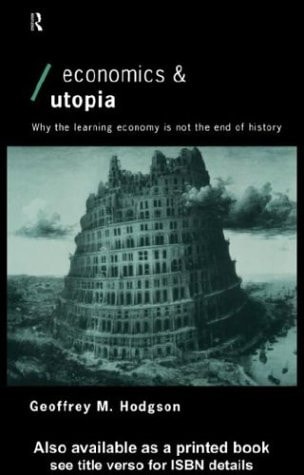
Economics and Utopia: Why the Learning Economy Is Not the End of History
0
0
As an Amazon Associate and affiliate partner, Menrva Books earns from qualifying purchases. Learn more
Author Description
For many, the East European revolutions of 1989 and the disintegration of the USSR represented not only the overdue demise of Soviet-style communism, but also the obsolescence of all utopian ways of thinking. History has reached its end-state in the form of a victorious liberal-democratic capitalism and all attempts to imagine an alternative social order were now damned as both futile and quixotic. Economics and Utopia rejects this stifling dogma in the belief that utopian thinking is a necessary condition for the development of alternative solutions to the problems of the present and thus for historical progress.Economics and Utopia is emphatically not an attempt to breathe new life into existing utopian models, whether state socialist or neo-liberal, which are seen as misunderstanding the nature of learning and knowledge in a modern economy. The author's utopianism is based on an examination of the potential for an alternative future based on the growth of knowledge-intensive production, one whose feasibility would derive from its ability to respond to the needs of rapidly-changing industrial economies. More than just a consideration of economic alternatives, Economics and Utopia is also an important contribution to the critique of mainstream economics which is considered to be unable to understand the market system except in the most formal and abstract terms. Thus in order to imagine new worlds a change in our economic thinking is necessary, one that focuses on the relationship between learning and knowledge in economic systems, as well as on the institutional and cultural context of different economic models.
Menrva's Summary
THE THESIS
This book investigates whether the collapse of Soviet-style communism truly signifies the end of history or if utopian thinking remains a vital tool for envisioning alternative economic futures. Geoffrey Martin Hodgson, a prominent institutional economist, challenges the prevailing dogma that liberal-democratic capitalism is the final stage of human development. By critiquing the limitations of mainstream economic theory, he argues that a deeper understanding of knowledge-intensive production and the institutional context of markets is required to foster genuine historical progress.
THE SCOPE MAP
What You Will Find
- A critical analysis of the relationship between learning, knowledge, and modern industrial production.
- A critique of mainstream economic models that rely on overly formal and abstract representations of market systems.
- An examination of the institutional and cultural frameworks necessary to support alternative economic structures.
- A theoretical defense of utopian thinking as a practical necessity for solving contemporary societal problems.
THE AUTHORITY PERSPECTIVE
Scholars in the field of institutional economics frequently cite this work as a significant challenge to neoclassical orthodoxy regarding the nature of market evolution. Readers often note the academic density of the prose, which requires a strong background in economic theory to fully grasp the author's arguments.
Page Count:
0
Publication Date:
1998-01-01
Publisher:
Taylor & Francis, Inc.
ISBN-10:
020306870X
ISBN-13:
9780203068700
Philosophy
Economics
Politics
History
Economic History
Social Theory
Community Tags
Other Editions(4)

Similar Books








Reader Comments
Share Your Thoughts
No comments yet. Be the first to share your thoughts!