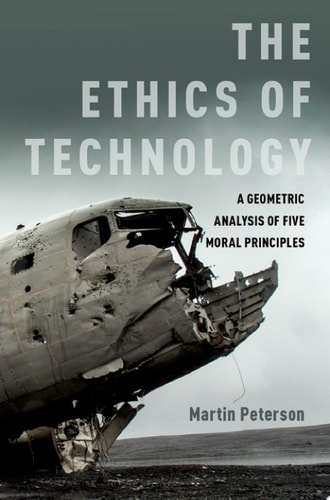
The Ethics of Technology: A Geometric Analysis of Five Moral Principles
0
0
As an Amazon Associate and affiliate partner, Menrva Books earns from qualifying purchases. Learn more
Author Description
Autonomous cars, drones, and electronic surveillance systems are examples of technologies that raise serious ethical issues. In this analytic investigation, Martin Peterson articulates and defends five moral principles for addressing ethical issues related to new and existing technologies: the cost-benefit principle, the precautionary principle, the sustainability principle, the autonomy principle, and the fairness principle. It is primarily the method developed by Peterson for articulating and analyzing the five principles that is novel. He argues that geometric concepts such as points, lines, and planes can be put to work for clarifying the structure and scope of these and other moral principles. This geometric account is based on the Aristotelian dictum that like cases should be treated alike, meaning that the degree of similarity between different cases can be represented as a distance in moral space. The more similar a pair of cases are from a moral point of view, the closer is their location in moral space. A case that lies closer in moral space to a paradigm case for some principle p than to any paradigm for any other principle should be analyzed by applying principle p. The book also presents empirical results from a series of experimental studies in which experts (philosophers) and laypeople (engineering students) have been asked to apply the geometric method to fifteen real-world cases. The empirical findings indicate that experts and laypeople do in fact apply geometrically construed moral principles in roughly, but not exactly, the manner advocates of the geometric method believe they ought to be applied.
Menrva's Summary
THE THESIS
This book investigates whether geometric concepts can provide a rigorous, structured framework for resolving complex ethical dilemmas in modern technology. Martin Peterson, a scholar in the field of ethics, proposes a novel methodology that maps moral principles onto a geometric space. By utilizing concepts such as points, lines, and planes, he argues that moral decision-making can be clarified by measuring the 'distance' between cases in a moral landscape, thereby determining which ethical principle should be applied to a specific situation.
THE SCOPE MAP
What You Will Find
- A formal analysis of five core moral principles: cost-benefit, precautionary, sustainability, autonomy, and fairness.
- A geometric methodology for evaluating moral similarity between cases.
- Empirical data comparing the application of these principles by professional philosophers and engineering students.
Scope Limits
- The text does not provide a comprehensive history of technological ethics.
- It does not offer specific policy recommendations for individual technologies, focusing instead on the analytical framework itself.
THE AUTHORITY PERSPECTIVE
Experts recognize this work as a unique contribution to applied ethics that bridges the gap between abstract moral theory and practical decision-making. Readers frequently note the academic density of the prose, which is best suited for those familiar with formal logic or philosophical methodology.
Page Count:
262
Publication Date:
2017-01-01
Publisher:
Oxford University Press
ISBN-10:
0190652284
ISBN-13:
9780190652289
Philosophy
Technology
Moral Philosophy
Ethics
Analytic
Applied ethics
Social Aspects
Trades & Technology
Community Tags
Similar Books